
With Google On Our Side

Penguin flapping wingsWhen people talk about the rise of China’s global economic power, I counter with: “Yeah, but we have Google.” Some times when people ask me a question I don’t know the answer to, I reply: “Google it.”

As a content writer, Google and I share a goal – useful, quality content on the Internet.  As stated in their Best practices #1: “Focus on the user and all else will follow.” It’s no longer a David vs. Goliath world. People and companies with good ideas and good products can prosper no matter what size.

A vice president at a telecommunications company said he was astonished by what Google knew about their customers.  The information was deeper and broader than anything the company had. It kind of scared him. With such knowledge comes revenue and responsibility. Decisions need to be made along the way. From what I see, Google is heading in the right direction.

Emphasis on Quality Content

I tire of seeing those who manipulate online pages be in more demand than those who create good content.  With its latest changes, Google seems to be tired of it too. Changes in its algorithm, Penguin, aim to rid us of schemers who use keyword stuffing and link tactics to improve rankings. Such practices are like playing multiple balls on each hole during a round of golf or adding clubs beyond the limit rule.

Panda bearFrom Google Best practices #3: Does this help my users? What if all the time companies spend on questionable SEO tactics was used instead to develop original, quality content for their audience? Another Google change, Panda, focuses on promoting sites with such content. Well-researched articles, in-depth reports, and thoughtful analysis are being rewarded with high rank. If you think this kind of content comes only from big companies with swarms of subject matter experts, think again. You may be surprised by what a company owner and a good content writer can create.

With Google on our side, content writers can empower companies by focusing on and helping their audience.

 

Google Places Out, Google+Local In

Google announced the launch of Google+local this week — a move which effectively converted more than 80 million Google Places pages into Google+local pages. So, if you didn’t get around to creating a Google+ page yet, you can thank Google for getting you started.

Local information integrated across Google

Of course, there’s a reason for all this, not the least of which is to gain more traction for Google+.  Users can now click on the new “Local” tab on the bottom left-hand side of Google+ to search for specific places or browse for locations. If you click on a restaurant, or a place, you’ll be taken to a local Google+ page that includes photos, Zagat scores and summaries, reviews from people you know and trust, and other useful information like address and opening hours.

As part of the move, Google replaced its five-star review system with the Zagat 30-point rating scale. Google has also added depth to the reviews by adding ratings on service, atmosphere and the like. Individual scores will be rated on a zero to 3 point scale, averaged and then multiplied by 10 to create an average score where 26-30 is near perfection and 0-9 is poor to fair.

26-30Extraordinary to perfection
21-25Very good to excellent
16-20Good to very good
10-15Fair to good
0-9Poor to fair

What’s a business to do?

For now, according to the Google and Your Business Blog, businesses should continue to update their company  info via their Google Places page, but eventually this will be phased out. If you already had a Google+ business page, you might check to be sure you don’t have two.

“If you are a business owner, you should continue to manage your information in Google Places for Business,”said Jen Fitzpatrick, VP Engineering, in the Google and Your Business Blog. “You’ll still be able to verify your basic listing data, make updates, and respond to reviews. For those who use AdWords Express, your ads will operate as normal as they’ll automatically redirect people to the destination you selected, or your current listing,”

Implications for local search

There is good news for savvy marketers who have already mastered Google+ because now these pages will be indexed and available across across all Google properties including search, maps and mobile. If you haven’t yet started on Google+, now is a great time to start. But like it or not, your low maintenance Google Places page is now a full blown social media site that needs your attention. Its time to expand your social circles, encourage reviews and engage your followers with great content. Google+ is flexing its local muscle.


3 Best Sites for Tracking Content Trends

Content writers and industry professionals need to track trends to stay current, find topic ideas to write about and learn what terms people are using to search the Internet. You can gage what keywords and topics are trending outside and within your industry, today, last month, and annually using these three best sites for content trend tracking. This is a routine I find effective as a content writer and communications strategist.

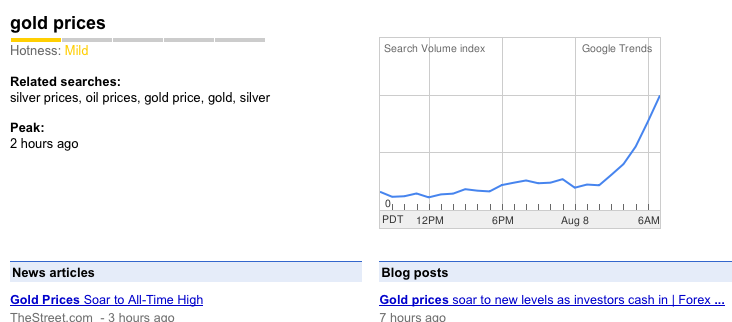
First, check out Google Trends. Early this morning some trending topics were “gold prices,” “Nestle” and “Stephen Hawking.” The price of gold is surging to new heights. If you are in the finance world, adding the words “gold prices” to your blog post,  e-newsletter, or social media titles today will likely increase your traffic.

Google trends page

You can change the date and see what the search trends were any day in the last year. Lots of people search for the Dow Jones Industrial Average using “djia.” Use the right abbreviations/terms and you have a better chance of connecting with your audience. Google Trends is updated every hour. You can subscribe to “Hot Trends” through an RSS feed.

Trends Buzz page

Trends Buzz gives a great overview of the most searched words at the moment on Google, Yahoo, Twitter, Alexa, Blogpulse, Wordtracker, Wikipedia and more.  Clicking on the term link opens up a listing of content on the subject.

Alltop pageMy other favorite site for reviewing trends and topics is Alltop. The home page has popular articles by good writers. You can search by industry or keyword to get all the most searched for topics. It’s sometimes hard for me to get off this page. It shows how great headlines draw reader interest.

Use these sites for tracking content trends and audience patterns emerge. Understanding how popular content fluctuates can help you plan your content accordingly. Knowing what words people use to search and the power of a good headline are added benefits of monitoring these 3 best sites for tracking content trends.

How are you using Internet trends to drive traffic to your site?

“Original” Fixes for Dealer Product Pages

Google's Panda UpdatePanda Update Poses a Problem for Dealers

The Komatsu PC108 Excavator sold at Kirby Smith in Oklahoma City, Okla. is the same as the PC108 Excavator sold at Road Machinery in Phoenix, Ariz. So it would make sense that the product pages on each dealer’s website would be nearly identical, right?

Of course. But it is exactly this kind of duplicate content that is negatively impacting search engine rankings for many businesses. The problem began in March, when Google made some changes to its algorithms in what was dubbed the Panda Update.

Many e-commerce retailers whose products are sold on multiple sites, experienced a drop off in traffic after Google initiated the changes. (Click here to read this discussion forum set up on Google.)

In their efforts to find the best and most relevant results for its users, Google has decided to place more value on original content–content that is not aggregated or syndicated from other sources. As a dealer, you can’t control the specs of the machine or the algorithm, but there are ways to build original content into your product pages and boost your search engine rankings once again:

Add Product Reviews:
Let your customers do the talking by allowing them to post reviews on machines they own or rent.

Add a Video, Podcast or other Descriptive Content: Video your salesman or manufacturer’s rep as they conduct a walk-around of the machine explaining all if its benefits. Focus on the types of applications that you are likely to see in your market.

Video or photograph the machine undertaking a specific task: Document its productivity. I like this demonstration of the Wacker Neuson Rebar Tier. Think of how you might conduct a similar test in your own market.

Provide a Side-by-Side Comparison: Do customers often waiver between two different machines? Put together the comparison specs and weigh the pros and cons of each model. What does each model do best? What is the cost/benefit analysis? Add this information to your product pages.

Add Additional Info:
What is the estimated cost of the machine over its useful life? How easy it is to do routine maintenance or change an attachment? These are questions you have probably already answered that can be easily added to your product information online.

In the wake of Google’s Panda Update, it’s more critical than ever to review your website’s analytics and determine what content and keywords are working and what’s not. Take an inventory of the content that already exists, identify what items can easily be added, and what you need to create. Let us know if we can help.