Build Relationships With Industry Journalists

industry journalistsYou start reading an article in a newspaper, magazine or website that covers your industry. It grabs your attention. You are learning something from the research and facts presented. It holds your interest. You like the way the article is written and look to see who wrote it. You even feel a desire to leave a comment or share it. This could be the beginning of a relationship with an industry journalist.

Having such a relationship with a journalist in your industry should add a satisfying dimension to your work and to theirs. When your voice is heard in respected media your authority increases. When a journalist includes compelling quotes and exclusive information he or she serves the audience well.

Industry journalists have distinct styles and approaches to their work. Know what kinds of stories and topics they cover. When you work in the same industry, you have a ready point of common interest. When you ask the journalist a question, you have a second point of commonality – you are both curious.

Whether you meet online, at an industry conference or cocktail party, avoid spin. You need to build trust and be relevant. An opinion is okay. Journalists often look for someone with a point of view. But they also have excellent radar for BS.

Most industry journalists build a strong network of sources in their particular industry. They look for people who have credentials, knowledge and a backstory. It’s easy to call someone an expert, but good journalists verify authority.

Being in the communication business, industry journalists appreciate good communication skills. I’m not talking about reciting the company message, but real dialogue. If you can articulate or simplify a complex idea with insight and eloquence, you become a valuable resource for a journalist.

Timing is an important element when interacting with a journalist. They are often working under deadlines. A quick response is always appreciated. But current news is not always what they are looking for. It’s okay to send updates on a story they’ve covered in the past or something that is upcoming. It’s a good idea to include why their readers will care about the information you present. Industry publishers know their readers well. They have a good sense of what’s relevant and what’s not.

When you have news to share, talk it over with the journalist. Any help you’ve given in the past will be reciprocated within the ethical boundaries journalists adhere to. Never ask them to stretch those boundaries. Mutual respect and trust are the foundation of all good relationships. A well-crafted, informative and interesting article is the end goal for industry journalists and the sources they
depend on.
Save

Save

Save

Save

Good Deeds Deserve Good Links

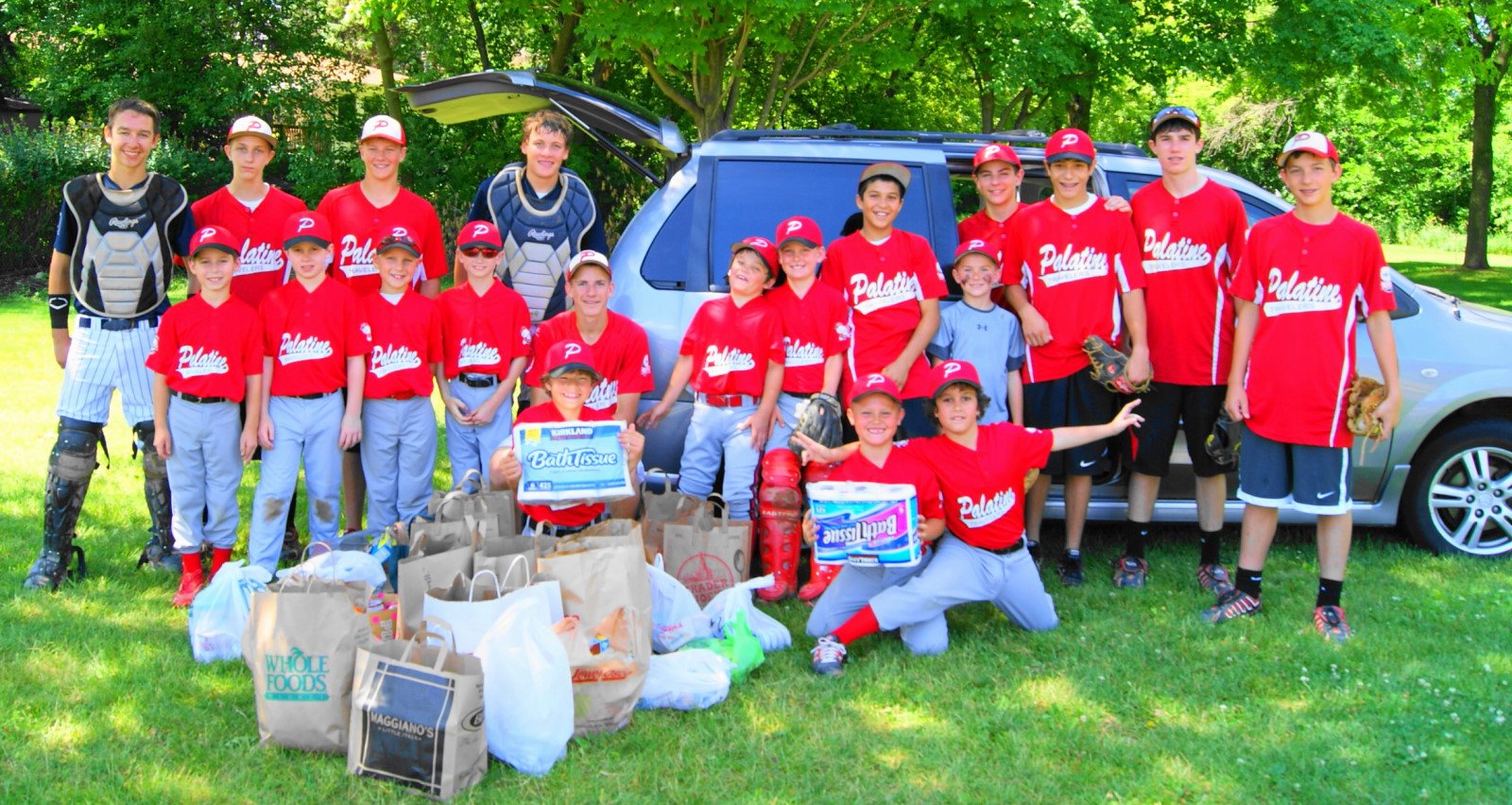
Baseball  Supports Food Pantry
Palatine Travelers Baseball Supports Food Pantry

People like doing business with with businesses that support their communities. Yet too often, businesses fail to capitalize on their contributions by ignoring the PR opportunities their good deeds provide.  Sponsoring local charities; bringing in students to explore careers; sending a team to participate in Relay for Life; are all good deeds deserving of attention by local media.

In Chicago, media sources such as Trib Local and Patch.com offer opportunities for anyone to post community news. As a result, you can build high quality links to your site by simply posting your press release to these sources. If those aren’t available in your area, the websites of the local newspapers will usually list an editorial contact or provide instructions for submitting a press release and photo. A public relations consultant can help write your release and distribute it locally at a very reasonable cost.

Some say B2B companies shouldn’t have a focus on local media or community events. I disagree. B2B decisions are made by people too. Even if I am not in your community, I want to feel good about doing business with your company. I am comforted to see your company is made up of real people with concerns for matters other than profit. And when companies are competing for talent, little things like charity events, can set your firm apart from the competition.

A project I worked on this week for my son’s baseball team (and the Palatine Township Food Pantry) reminded me how happy charitable organizations are to have their efforts supported with public relations. Whatever your event contributes to a charity, adding in a press release to provide additional exposure provides a huge bonus. You are helping build awareness for the charity, showing recognition to participants, and giving your business a little bit of credit.

RDO Equipment, a construction equipment dealer headquartered in North Dakota, is one company who gets it right. Their website is brimming with examples of how their local branches support their community. I admire RDO and all the companies like them, who are helping those in need.  Isn’t it time to take some credit?

Good deeds deserve good links. What companies in your community stand out for their community service? Tout them here in our comments. We’ll give them some well deserved recognition.


Chicago Builder of LIFEhouse Project Generates More Than Publicity

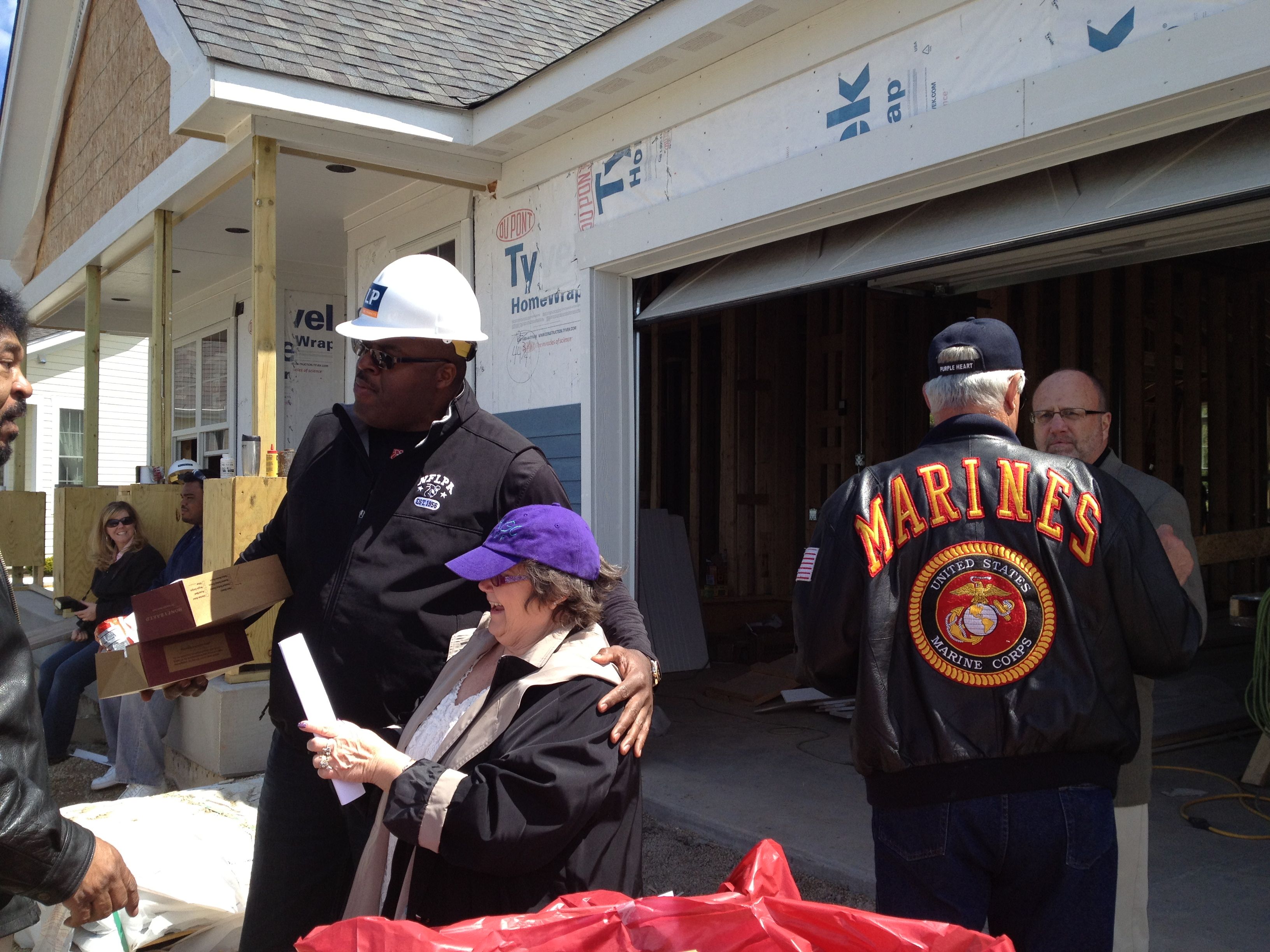
Supporters at Newport Cove LIFEhouse for a Hero eventIt’s Memorial Day, 2012. This time next year an able but physically disabled veteran wounded in action during the Iraq or Afghanistan war will have a safe, comfortable and beautiful home to live in. The LIFEhouse™ is the second of its kind being built at Newport Cove near Antioch, Illinois. The original house was built in collaboration with the IDEA Center at the University of Buffalo, State University of New York, known for its design work in accessibility.

After walking through a model of the home located on Bluff Lake, an anonymous donor asked builder Susanne Tauke, president of New American Homes, to build one for a wounded vet. She named the project LIFEhouse for a Hero.

Tauke solicited help from several organizations and suppliers who stepped up to donate time and materials and help plan events. The Home Builders Association of Greater Chicago, Operation Finally Home, the Chicago NFL Players Association and suppliers including LP Building Products, Wausau Supply, Andersen Windows and lots of local trades people: plumbers, surveyors, and carpenters were ready to lend their support.

A press release sent out for an event in April announced that former NFL players would be helping put up siding on the house.  Vets showed up at the event too, some from the Vietnam War. “Same blood, different mud,” one said about why he had come. The event generated news stories online, in radio, TV and print.

Newspaper Looks at Relevance Over Immediacy for LIFEhouse Hero Story

While most media published the story on the day of the event, one newspaper, the Northwest Herald, released the LIFEhouse for a Hero story on Memorial Day weekend.  Timing is important with news coverage, but this shows you needn’t always be first. Relevance can trump immediacy. Someone at the newspaper held the story until Memorial Day weekend, a timely fit for readers. Review your own editorial calendar or topic list and see what is best to publish and when.

What’s special about the LIFEhouse is more than how it originated. The ranch style layout features coastal architecture, has a large finished basement, wide doorways and hallways, hard wood flooring and no-step entrances.  Based on universal design principles, this house is for everyone, and someone special – a wounded vet with mobility challenges. Targeting services or products for someone in particular can increase its appeal because there is a story to tell.

Tauke is candid about how the slow economy has impacted builders. “I’m truly grateful for all the people who have helped with this project. I know times are hard.” Then she says out loud what she’s been thinking all along. “I consider what the veterans of war have gone through and decide I am in a privileged position to orchestrate something positive – a house that will become a home for a wounded veteran and family.”

4 Ways Google Authorship Magnifies Your Expertise

by Mary Klest

If you or someone in your company is a subject matter expert (SME) with an ability to write for an audience, Google Authorship content can bring you one step closer to building trust and authority outside of your current professional network.  This is a good reason to join Google+ if you have not already. By displaying author information in search results Google’s intent is to decipher and make available high quality content for search users. They also want to build the Google+ network.

Personalize Search Results

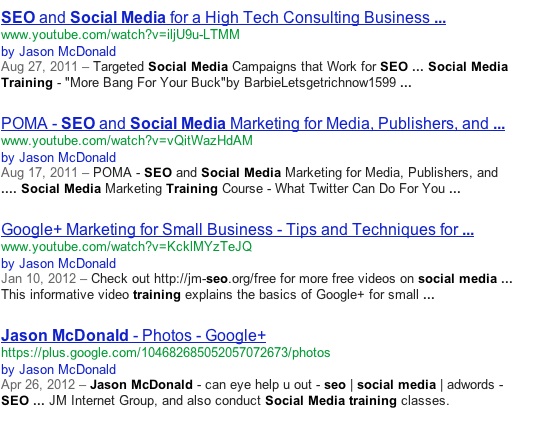
A Google Authorship annotation looks and functions better than regular Google search results. It includes a photo. This tells the searcher it was written by a person, not an organization. The photo shows the person’s gender and approximate age. It personalizes your content before it is even clicked on. The annotation also includes two author links that serve different purposes. Here is what such an annotation looks like for my search term “SEO Training Classes”:

Google authorship search result


Increase Your Following

Before clicking on the title link hover your cursor over the “by (author name)” link. You are invited to add the author to your Google+ circles. As an author, you can increase your following dramatically this way. If the author is already in one of your circles it will show that. Note the number of circles the author is listed on as well. This indicates how connected the person may be.

Click on “by (author name)” and the content created for the title link appears. Click on the “More by (author name)” link and you see a listing of annotations by that author as in the example below.

Google authorship of Jason McDonald


I like Google Authorship’s ability to give users a snapshot view of an author’s published work on the Web. It also gives authors the ability to add and share their work as they see fit.

Find Journalists & Share Information

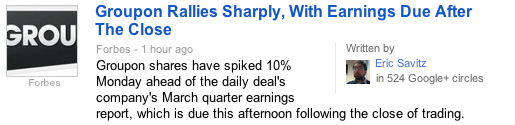
Articles written by journalists with a Google+ profile appear in Google News with their profile added. Lots of reporters writing for Forbes appear in Google News search lists.  By clicking on Eric Savitz’s name I learn he is the San Francisco Bureau chief for Forbes magazine. I see his email address and add him to one of my circles.

Google authorship journalist profile


Look for journalists who cover your topics. Build a relationship by sharing information on your area of expertise. You may be quoted in influential media and generate good publicity for yourself.

Weigh Your Influence With Google Social Reports

Authors need to create high quality content and be mindful of what audience they want to reach. Google recently bought PostRank and is rolling out social reports in Google Analytics. You can analyze traffic, optimize engagement, and make data-driven decisions. In Google+ you can also see what impact the content has had by using Google Ripples. It shows you who shared the content publicly, how it’s doing over time and other statistics.

If you want to get started here’s how to link your content to your Google + profile and get your content annotated in search results. Two different methods can be used depending on whether or not your Google + email address holds the same domain name as the site where your content appears.

These are just a few ways Google Authorship content can magnify your subject matter expertise.  Are you ready to share it?


Content Writing Lesson for Food Service: Swap Broad Terms for Specifics

Berries from Brazil
Berries from Brazil

Many companies have jumped on the green bandwagon and for good reason. Consumers favor environmentally friendly brands and companies want to do the right thing. However, as a result of this movement, words like sustainable and organic have been bandied about with increased frequency. But what do these words mean to consumers?

Research conducted by The Hartman Group suggests that the words “sustainable” and “organic” are confusing to consumers. At the Protein Innovation Summit, Tamara Barnett, director, strategic insights,  Hartman Group, advised food suppliers and restaurant operators to scrap words like sustainable and organic in favor of words that consumers can more readily understand. According to Barnett, consumers want to know where food comes from, so information about where a product is sourced from is important. Consumers want to know food comes from a real place. Consumers want to know how your practices impact quality. Educate and explain your practices with specifics rather than generalities.

On the menu and on your website, answer the question of where your food comes from. Explain what it does for the consumer (environmental or health benefits). Showcase your suppliers. “Consumers want to work with a company that is a good neighbor,” said Barnett. It is increasingly important to show a connection to the community that uses your product.

Don’t forget that authenticity can be conveyed not only in words, but in pictures. Photos of real customers, employees and places, build trust.

As content writers we combines words and pictures to impart meaning. We can review your current website copy and edit for clarity and substance. We will scrap confusing words in favor of more descriptive terms and keywords. It is not enough to be sustainable or organic.