B2B Content Marketers to Increase Spending in 2012

Content Marketing GrowthIn a recent survey conducted by the Content Marketing Institute and Marketing Profs,  60 percent of B2B marketers said they would increase content marketing spending in 2012. On average, the marketers surveyed spent 26 percent of their total budget to content marketing initiatives.2012 Content Marketing Spending
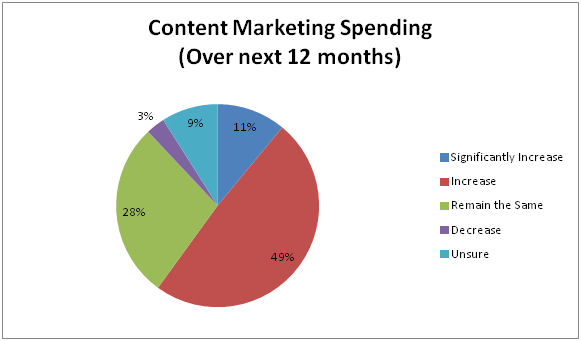
Source: Content Marketing Institute/Marketing Profs 2011

What’s fueling the increase? One reason may be increased effectiveness among marketers using various tactics. Effectiveness ratings for blogs saw a 45 percent jump in 2011, while those for videos increased 36 percent.  Case studies and webinars/webcasts also showed significant increases in effectiveness.

Overall, in-person events, webinars and case studies are seen as the most effective strategies (more than seven out of 10 respondents ranked these as effective). Social media was viewed as the least effective strategy, but scores improved significantly from 2011. Sixty-one percent more marketers ranked it effective in 2011 vs. last year.

More B2B Marketers Outsource Some Content

With greater content needs, more marketers are outsourcing. Sixty-two percent of respondents use a mix of in-sourced and outsourced content, up from 55 percent in 2010. Outsource only strategies are rare at 4 percent.  On average 25 percent of the content creation budget involves outsourced resources.

The content marketing strategies on the upswing are blogs (+11%), video (+11%) and whitepapers(+8%). While some tactics such as print magazine, print newsletters and ebooks showed declines.

As content marketing grows, marketers are developing new ways to measure effectiveness. While measuring web traffic (58%) and sales lead quality (49%) are still the most popular measures, SEO ranking jumped 12 percentage points in just a year with 40 percent of respondents using it to measuring results.

The survey was mailed electronically to a sample of B2B marketers from among members and subscribers to MarketingProfs and the Content Marketing Institute. A total of 1,092 responded worldwide with the majority based in North America. The respondents represent a range of functional areas, industries and company sizes.

How does this compare to your 2012 plans?

Can an Online Product Demo Help Your Sales?

Is your sales force sending mixed messages? Are your marketing materials gathering dust in the reception area? Do you want your content to sell products? A product demo can generate qualified leads and be shared on multiple platforms including sales team laptops and YouTube. Product demos can help ensure a consistent message and maximize your return on investment by engaging your prospects.

First, figure out what your objective is. Do you want to introduce new product features or simply show what the product does to make prospects’ work life easier? How will it align with your business goals?

Second, how much production do you need? Find the resources you need to produce the demo. An affable, knowledgeable salesperson or engineer may take the leading role or you may want to produce a 3D animation. Whichever, make sure your product appears in a nicely staged setting.

Here is an example I found on YouTube.  The WD-40 Company has their VP of  Research and Development, Dr. Ernie Bernarducci, talk about the New Smart straw applicator, the big blast can with wide mouth applicator, and a new no mess pen – as well as a brief mention of existing products. He gives credit to customers for sharing their ideas on WD-40 uses and then finishes with a call for action. Currently, the video demo has been viewed by 31,607 people.

Product demos can be put on your website, in your newsletter, and shared through social media networks and email using links. Content should focus on what the product does and benefits of use, followed with a call for action.

Another approach is to use animation such as this one from Spirax Sarco, a company that sells products using steam, air and industrial fluids. Their audience is industrial and commercial users. This 30-second animation has had 8,344 views on Youtube. I think it could have been more effective had they included a voice over narrator describing what the product is, who uses it, and where one can be found. But, it is an effective way to show the internal parts of a complex mechanism.

Services and software solutions can also be demonstrated. Constant Contact E-mail services can be viewed through a Product Tour available on the website.

A well-crafted script for the demo can help keep your message consistent and focused. Let your product spring to life right before the eyes of those who will benefit most from its use.  When your customers need to see before they believe, create a product demo.

Use “3D” Content to Position Your B2B Brand and Attract the Customers You Desire

Man with video cameraAs content writers we have to be careful not to focus too heavily on words, when sights and sounds might communicate more effectively.

In trying to build a website that reflects your B2B brand, think of how you might utilize “3D” content.

When a customer walks into your office or place of business, what do they see and hear? What does it reveal about the brand?

I think for service firms, this is especially important. Décor and dress can say more about the company’s culture and working style than text. If you walk in and the business owners are young, dressed casually, and working in an open space, it says something quite different than seeing employees dressed in a suits and ties in a wood paneled office.

If you’re a construction equipment dealer whose shop is clean and well organized, with state-of-the-art equipment, why not show it off in a video tour?

Instead of traditional headshots, photograph employees in an environment that offers a sense of how and where they work.  If they are often in the field, working with customers, show them there.

Choose a webinar format over a whitepaper and evaluate how customers respond. Add a moderator or interview a customer to make the tone more conversational and friendly.

If you provide instructions for completing a task, consider if a video demonstration is likely to be clearer and more compelling than written instructions.

Don’t overlook an opportunity to use music to convey mood and emotion. What do you want people to feel when they visit your website?

Little things do matter to your potential customers who are going to your website to find out more about you.  People want to do business with people and brands they like.  Copy alone won’t be enough to convey all that is unique about your business and the people you employ.

When words, pictures, sound and video work together, your B2B brand’s personality will shine through, attracting the customers you desire.

“Original” Fixes for Dealer Product Pages

Google's Panda UpdatePanda Update Poses a Problem for Dealers

The Komatsu PC108 Excavator sold at Kirby Smith in Oklahoma City, Okla. is the same as the PC108 Excavator sold at Road Machinery in Phoenix, Ariz. So it would make sense that the product pages on each dealer’s website would be nearly identical, right?

Of course. But it is exactly this kind of duplicate content that is negatively impacting search engine rankings for many businesses. The problem began in March, when Google made some changes to its algorithms in what was dubbed the Panda Update.

Many e-commerce retailers whose products are sold on multiple sites, experienced a drop off in traffic after Google initiated the changes. (Click here to read this discussion forum set up on Google.)

In their efforts to find the best and most relevant results for its users, Google has decided to place more value on original content–content that is not aggregated or syndicated from other sources. As a dealer, you can’t control the specs of the machine or the algorithm, but there are ways to build original content into your product pages and boost your search engine rankings once again:

Add Product Reviews:
Let your customers do the talking by allowing them to post reviews on machines they own or rent.

Add a Video, Podcast or other Descriptive Content: Video your salesman or manufacturer’s rep as they conduct a walk-around of the machine explaining all if its benefits. Focus on the types of applications that you are likely to see in your market.

Video or photograph the machine undertaking a specific task: Document its productivity. I like this demonstration of the Wacker Neuson Rebar Tier. Think of how you might conduct a similar test in your own market.

Provide a Side-by-Side Comparison: Do customers often waiver between two different machines? Put together the comparison specs and weigh the pros and cons of each model. What does each model do best? What is the cost/benefit analysis? Add this information to your product pages.

Add Additional Info:
What is the estimated cost of the machine over its useful life? How easy it is to do routine maintenance or change an attachment? These are questions you have probably already answered that can be easily added to your product information online.

In the wake of Google’s Panda Update, it’s more critical than ever to review your website’s analytics and determine what content and keywords are working and what’s not. Take an inventory of the content that already exists, identify what items can easily be added, and what you need to create. Let us know if we can help.