Does Your Content Travel Well Across Channels?

Think of a well-packed suitcase. The size limits its capability, but not its function. Constraints can be good especially if you need to carry your bag from place to place or when you need your content to travel well in all conditions and across channels. By that I mean gaining attention amidst the flurry of headlines, tweets, posts and images that fly past us each day. We are all confined by time and space. So my thought is to use it wisely. Like the suitcase, you need to pack your content well.

Many people won’t believe that you can pack for a weeks-long trip in a carry-on bag. But this video shows you how to do just that – pack light and right. The same holds true for your content. You can say a lot with few words in a quick channel (think twitter) when the words are chosen for a particular audience or experience.

You may find that at first the pant legs and shirt sleeves are hanging outside the bag. But with the proper fold and sequence of garments the secret to the process becomes apparent. Writers are your content packers. They know how to structure and edit content.

The next time you need to inform, educate, entice or engage an audience, hire a qualified content writer to create and spread the word. In the digital world your content can travel fast from network to network, blog post to website, or image to email. Whatever route it takes, pack it right.


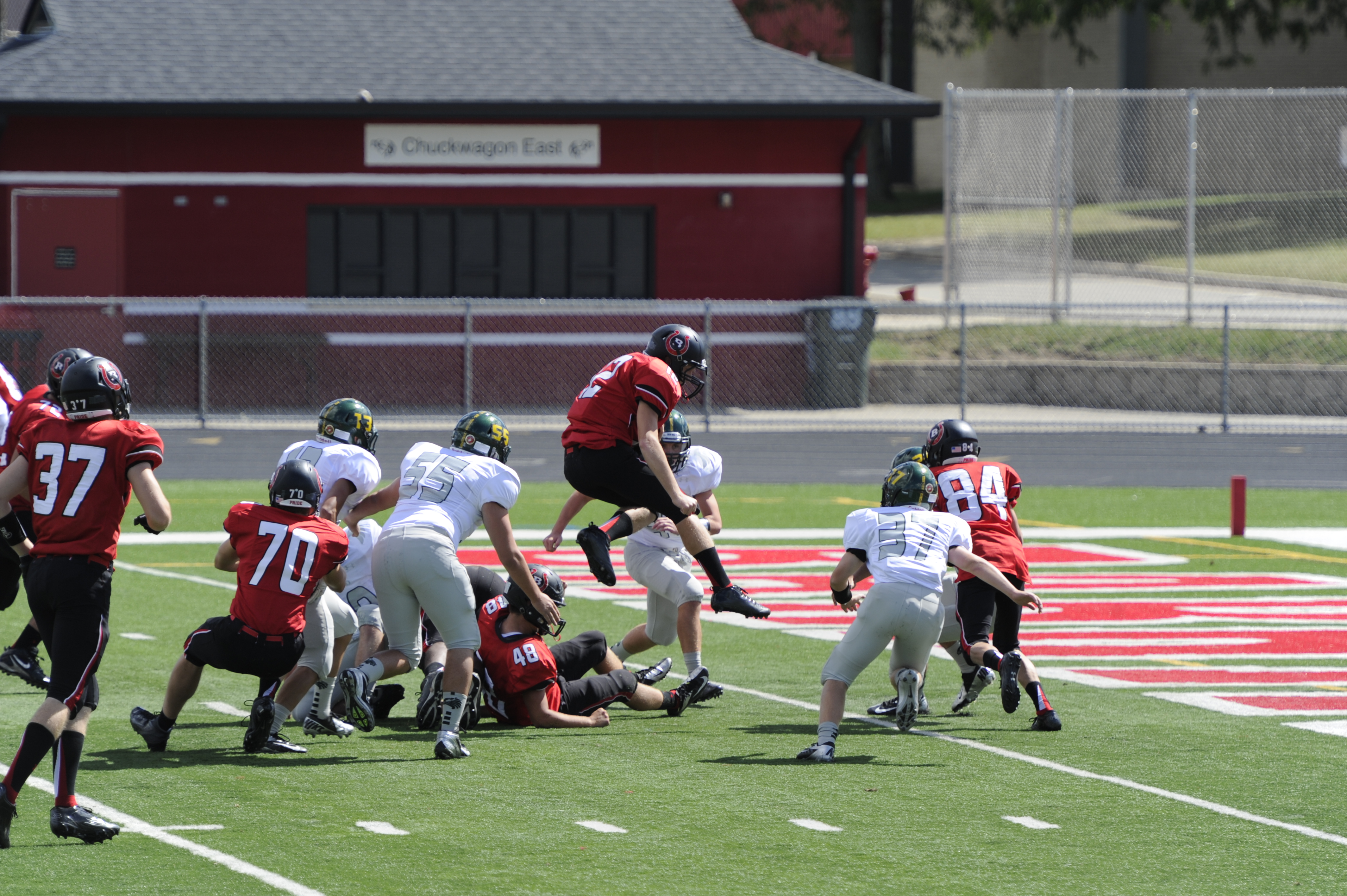
Content Lessons From High School Football

Getting to the goal line

Can a high school football game uncover content lessons for B2B companies? You bet, at least in the mind of this content writer. While watching the game I get an understanding of why it’s important to assess opponents, signal a new play, execute, and connect with an audience. Watch this video that shows a fake handoff by the quarterback, a play that initiates a 65-yard run to score a touchdown. That play didn’t just happen. It was planned.

Understand your Opponents

Your competition is one form of opponent but another is the customer who struggles with his or her end goals, resources and budget. Content that acknowledges those concerns is like good blockers paving the way for the quarterback’s run.

Signal a New Play

If the passes are not caught and the handoffs go nowhere, reimagine your role. No football game is the same and the same holds true for company initiatives. High school kids hear from the coach: “Don’t repeat your mistakes, learn from them.” For companies, content is measureable. Sometimes it takes a bit of tweaking but you can reach your content goals. Yesterday’s content won’t support new ideas.

Execute

Watch what the quarterback does to make the opponent team change direction. You want your content to do the same – get your audience to change direction toward your solution. Get them thinking differently about what is important, performance and balancing cost.

You Gotta Feel It

Include some sensory element that allows your audience to experience emotion. At the football game you hear the roar of the crowd and clapping. Content writers use language and visual design to create mood and tone.

Add an unexpected connection the way this home game announcer did after reporting the touchdown play: “That a boy.” And, “This kid is deceivingly fast.” As for the quarterback, he said: “Just before the play I had a feeling: ‘This is it.” That’s the feeling your content can relay: This is it.

Problem-Finding Inspires Construction Content Writers

Construction machinery trackTo attract prospects to your website, construction content writers should practice the art of problem-finding.  Identifying the problems your products or services solve is key to creating content that will be a magnet for web traffic. Answers to “What’s the problem?” aren’t always apparent. Uncovering how your products and services solve problems is good for both business and content.

Track pad manufacturer BLS has done a great job of identifying and solving customer problems. Track pads protect streets from the damaging effects of track-type construction vehicles. But when a customer asked BLS founder Barry Stoughton to find something that would last longer, he decided to make the pads out of polyurethane instead of rubber. Longer-lasting pads reduced the cost for contractors.

Barry followed his customer’s balance sheets to identify more problems, and then solutions.  Knowing equipment maintenance is costly, Barry soon manufactured clip-on and bolt-on track pads that could be installed faster. Other BLS track pads are designed to minimize soil compaction.  Each problem has its own audience.

Listen in on conversations about your products on social media. Participate in discussions on Forums and within LinkedIn groups to learn the language of customers. Problem-focused web content  can even lead to new applications for the product. Knowing what equipment works best in a specific construction application adds value, as does versatility.

Take a lesson from WD 40 — a brand built around more than 2,000 uses of the product. Does your website encourage questions and foster community like WD 40’s?

Here are some good ways construction marketers and content writers can find  “problem” talk for their website:

1) Create your very own contractor forum.

2) Ask customers to submit new applications for your product.

2) Conduct customer interviews among different types of customer groups such as landscapers vs. building contractors.

3) Monitor forums for questions related to your products. Start a Q&A column or blog  on your website.

4) Develop an advisory board for your product comprised of people who use the product or service regularly.

5) Solicit product usage tips from the professionals and build community around information sharing.

6) Give fans reasons to interact with you. Find a good cause to unite you.

7) Celebrate your customers. Submit photos of customers using the product to feature on the site. Reward great photos as well as interesting product applications.

You can’t solve a problem until you fully understand it. Make problem-finding research part of your process.


The What, When and Where of Content that Converts from Dan Zarrella, Science of Inbound Marketing

Inbound marketingDuring the Science of Inbound Marketing webinar Hubspot social media scientist Dan Zarrella talks like a radio traffic announcer, barely stopping to catch his breath. His tone relays excitement, value, now. He’s fast and fruitful sharing his results on content that engages and converts.

Right away Zarrella asks his audience to start tweeting. He offers a reward for those who tweet the most during the webinar. According to the data he collects and analyzes, those who ask for retweets get more of them. Zarrella definitely wants more – for everyone.

Here is my summary of the data results he shared on inbound marketing.

E-books

More people prefer reading e-books on Kindles that are less than 5 pages or more than 100 pages. Business books are still favored in print.

Facebook

Self-referential, positive sounding posts with photos, posted on Saturday or Sunday receive the most “Likes”. During the week posts are more popular between the hours of 6pm and 11pm.

Twitter

Contrary to popular belief, the highly followed on twitter are less conversational than average. Sixty to 80% of retweets contain a link. The “Please retweet” phrase quadruples chances of being retweeted. Popular time of day for tweets is 4:30pm.

SEO

Keep page titles short. No need to hire an SEO specialist. Rely on a content writer to create and optimize relevant content to get links.

Blogging

Seventy percent of decision makers report being influenced by a business blog when making purchasing decisions. They read blogs more than once a day. The best time to publish is between 9-10:00am. To receive more links publish earlier 6-7:30am. More posts, more views. The number of comments doesn’t correlate with links/shares. People are looking for a personal perspective on blogs – insights, questions, answers and reviews.

Email

Zarrella says he would trade twitter followers for email subscribers. His research shows the following factors can influence email effectiveness.

  • Show some passion in your email subject line to get more opens.
  • Use ampersands[&] in titles to get more click throughs.
  • Include multiple links in the text.
  • More is more. There are no detrimental effects from sending out lots of emails. Unsubscribe rates are higher when fewer emails are sent.
  • Avoid questions in the subject line.
  • Don’t use (parenthesis), use [brackets instead] in text.

Forms

Don’t ask people for their age. The word “Submit” has a lower conversion rate than others such as “Sign Up” or “Register”.

Zarrella reported that the Science of Inbound Marketing webinar generated 20,000 tweets. That’s impressive. It would be interesting to know how many of those people become email subscribers and buyers. But that is beyond Zarrella’s focus. His data driven perspective is unique giving inbound marketers clues to the what, when and where of content that converts.

What most influences you to register for and attend webinars? Is it the name of the host? The topic? Time of day?

Content is a Functional Part of Website Development

Computer screens with contentWebsite development teams often leave content writing up to the business owner or outsource it at the last minute. Such an oversight can postpone the project or render the site unusable. They are missing an opportunity to make the site function as the company intended – as a business tool. If payment is tied to the site going live they may also experience a delayed paycheck.

To build a truly functional website, content writing responsibilities need to be delegated early to a skilled writer who makes content a priority. Just as graphic artists make visual design a priority and programmers make code their priority, content writers delve deep into what the business objectives are for the site. Content begins a conversation between the company and site visitor. Words inform, engage, and when strategically employed, live up to the visitor’s expectation. Visitors don’t expect to be assaulted by ugly design or frustrated by features that crash or content that doesn’t answer their questions.

Keep the Project On Track

I asked some web development pros I know for their views on the content writer’s role. Here’s what Dan Halt, principal at Balta Design, a web development and design firm, has to say:

“The thing that slows us down the most is not having the content ready from the customer. Having the copy written by a content writer, instead of the customer, usually speeds up the process. One of the most beneficial things someone can get from a content writer is their content will be written with SEO in mind. Most business owners don’t have the time to write the content for their site (or at least the quality time it takes). That’s why it’s better to hire a professional, in my opinion.”

Kay Wharton, owner of Wharton Graphics, shared similar ideas. She said, “I prefer at least rough content (headlines and estimate of copy to come) before design begins. I can greek in text, but if I could have all the copy that’s even better. I want the content writer to understand some editing may be necessary to make the copy fit the design. There may need to be a little back and forth during the process.”

Bring in a content writer early for web development projects. The site will likely be completed on time, function well, and meet your business objectives. Companies reap rewards when content writing is prioritized as a functional part of website development.