Google Places Out, Google+Local In

Google announced the launch of Google+local this week — a move which effectively converted more than 80 million Google Places pages into Google+local pages. So, if you didn’t get around to creating a Google+ page yet, you can thank Google for getting you started.

Local information integrated across Google

Of course, there’s a reason for all this, not the least of which is to gain more traction for Google+.  Users can now click on the new “Local” tab on the bottom left-hand side of Google+ to search for specific places or browse for locations. If you click on a restaurant, or a place, you’ll be taken to a local Google+ page that includes photos, Zagat scores and summaries, reviews from people you know and trust, and other useful information like address and opening hours.

As part of the move, Google replaced its five-star review system with the Zagat 30-point rating scale. Google has also added depth to the reviews by adding ratings on service, atmosphere and the like. Individual scores will be rated on a zero to 3 point scale, averaged and then multiplied by 10 to create an average score where 26-30 is near perfection and 0-9 is poor to fair.

26-30Extraordinary to perfection
21-25Very good to excellent
16-20Good to very good
10-15Fair to good
0-9Poor to fair

What’s a business to do?

For now, according to the Google and Your Business Blog, businesses should continue to update their company  info via their Google Places page, but eventually this will be phased out. If you already had a Google+ business page, you might check to be sure you don’t have two.

“If you are a business owner, you should continue to manage your information in Google Places for Business,”said Jen Fitzpatrick, VP Engineering, in the Google and Your Business Blog. “You’ll still be able to verify your basic listing data, make updates, and respond to reviews. For those who use AdWords Express, your ads will operate as normal as they’ll automatically redirect people to the destination you selected, or your current listing,”

Implications for local search

There is good news for savvy marketers who have already mastered Google+ because now these pages will be indexed and available across across all Google properties including search, maps and mobile. If you haven’t yet started on Google+, now is a great time to start. But like it or not, your low maintenance Google Places page is now a full blown social media site that needs your attention. Its time to expand your social circles, encourage reviews and engage your followers with great content. Google+ is flexing its local muscle.

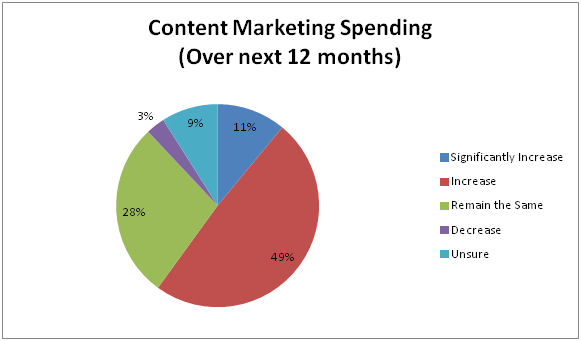


B2B Content Marketers to Increase Spending in 2012

Content Marketing GrowthIn a recent survey conducted by the Content Marketing Institute and Marketing Profs,  60 percent of B2B marketers said they would increase content marketing spending in 2012. On average, the marketers surveyed spent 26 percent of their total budget to content marketing initiatives.2012 Content Marketing Spending

Source: Content Marketing Institute/Marketing Profs 2011

What’s fueling the increase? One reason may be increased effectiveness among marketers using various tactics. Effectiveness ratings for blogs saw a 45 percent jump in 2011, while those for videos increased 36 percent.  Case studies and webinars/webcasts also showed significant increases in effectiveness.

Overall, in-person events, webinars and case studies are seen as the most effective strategies (more than seven out of 10 respondents ranked these as effective). Social media was viewed as the least effective strategy, but scores improved significantly from 2011. Sixty-one percent more marketers ranked it effective in 2011 vs. last year.

More B2B Marketers Outsource Some Content

With greater content needs, more marketers are outsourcing. Sixty-two percent of respondents use a mix of in-sourced and outsourced content, up from 55 percent in 2010. Outsource only strategies are rare at 4 percent.  On average 25 percent of the content creation budget involves outsourced resources.

The content marketing strategies on the upswing are blogs (+11%), video (+11%) and whitepapers(+8%). While some tactics such as print magazine, print newsletters and ebooks showed declines.

As content marketing grows, marketers are developing new ways to measure effectiveness. While measuring web traffic (58%) and sales lead quality (49%) are still the most popular measures, SEO ranking jumped 12 percentage points in just a year with 40 percent of respondents using it to measuring results.

The survey was mailed electronically to a sample of B2B marketers from among members and subscribers to MarketingProfs and the Content Marketing Institute. A total of 1,092 responded worldwide with the majority based in North America. The respondents represent a range of functional areas, industries and company sizes.

How does this compare to your 2012 plans?

How a Blog Helped a Chicago Commercial Contractor Win New Business

Marshall Field's Clock in Chicago, IllinoisIf you are a contractor and have doubts about whether or not a blog would increase your online visibility; listen to Chuck Taylor. He is director of operations for Englewood Construction Inc., a commercial construction general contractor based in Lemont,Ill., a southwest suburb of Chicago.  I met Chuck at the Construction Writers Association annual meeting in San Antonio, Texas, where Englewood Construction received an award for the construction industry’s best blog.

Their commercial construction blog, Hard Hat Chat, has brought in new business and opportunities for Englewood Construction. “There has been a return on investment that we never anticipated,” said Taylor.

Before starting the commercial construction blog, the company’s visibility on search engines was low. But with updated, quality content that provides valuable information to their market, Englewood Construction’s online visibility has increased dramatically. According to Taylor, the blog has helped place the company on the short list with national retailers and hoteliers they were not previously pursuing. In fact, they recently won a job from a major insurance company who initially found them through the blog.

The Biggest Concern:  Coming Up with Content

At the onset of the blog, Taylor was concerned about where the content for the blog would come from. He quickly found out that it wasn’t a problem at all. “We take for granted what we do on a daily basis,” said Taylor. “What our PR firm was able to do was ask us some engaging questions, such as ‘How did you overcome those challenges?” Posts are informative, keyword rich and optimized for local search.

Taylor and William Di Santo, president of Englewood Construction, share responsibility for the blog posts along with their PR fim. Chuck Taylor typically spends about four to six hours per month on a post.  The company scaled back the frequency  of blog posts during the market downturn, but expects that they will need to post more frequently in the near future, as more firms enter the construction blogging arena.

”Based on our activity we have more to talk about,” said Taylor. ” There are more opportunities coming in and it is not going to be long before the competitions catches on.”

Englewood Construction’s blogging efforts are focused on improving online visibility, rather than building a subscriber base or generating advertising revenue. “The end game is searchability,” said Taylor. “If you are not on the first page of the search results, you are not there.”

In fact, if you are a commercial contractor, Taylor would rather you wouldn’t read this.

Give us a call to discuss content for your commercial construction blog. And a special thanks to Englewood Construction for sharing their blogging experience with us.

Useful Resources for Creating Social Media Guidelines

Federal Trade Commission LogoIn 2010, the Federal Trade Commission revised its Endorsement Guidelines to include social media. What is said on blogs and social networking sites  now is not just a matter of ethics, it is the law.  The revised guidelines focus on three areas:

1) Endorsements must be truthful and not misleading

2) If the advertiser doesn’t have proof that the endorser’s experience represents what consumers will achieve by using the product, the ad must clearly and conspicuously disclose the generally expected results in the depicted circumstances; and

3) If there’s a connection between the endorser and the marketer of the product that would affect how people evaluate the endorsement, it should be disclosed.

As a marketing manager it is your responsibility to  protect your company from all of the legal implications of social media. This is best done by establishing a social media policy and by ensuring that all internal departments involved in social media as well as external agencies, consultants and contractors are aware of the policies.

Fortunately, there are a number of resources available to help.

SocialMedia.org recently updated its Disclosure Best Practices Toolkit, which includes a series of checklists to help marketers formulate a social media policy.

In addition to publishing the Endorsement Guidelines, the FTC also published a document which covers commonly asked questions about the guidelines.

View the video for a quick overview.

Do you have a question concerning disclosure or developing a social media policy?  Submit your questions to jcostin@contentforbiz.com.

For Better Website Content Focus on Market Segments

Restaurant RibsWhen we think of our products and services generically, our “stories” become less interesting and lack detail. Instead, position your company relative to the needs of a specific market. I recently reviewed the website content of a credit card fulfillment company serving a wide variety of industries – including retail, foodservice, small business and non-profits. While there was a unique page geared to each audience, the majority of the website content failed to address any specific industry concerns. When it comes to website content, problems become opportunities. Think of the problems that customers are looking to solve.

Instead of generic credit card processing, think credit card processing for restaurants. The National Restaurant Association is currently lobbying to reduce the fees charged by credit card companies, which can amount to the third largest expense behind food and labor.  Here are some website content ideas I suggested to drive traffic and convert visitors into buyers:

1) “Know the Hidden Costs of Payment Card Processing for Restaurants,” could be a downloadable whitepaper while “Three Ways to Save on Credit Card Processing,” might be the subject of a blog post that relates specifically to the highest cost drivers for restaurants.

2) A website calculator would allow restaurant operators to estimate their monthly charges and compare it to their current provider.

3) Updates on pending credit card legislation could be posted on the company blog, along with the opinions of restaurant industry leaders.

The restaurant industry is also among the most vulnerable to credit card fraud. Website content addressing data security should showcase how problems occur and what restaurant operators can do to better protect customer data. Solutions should go beyond technology. Here are some website content ideas related to credit card fraud in the restaurant industry:

1) Restaurant credit card fraud news would detail recent breaches within the industry and suggest the implications for restaurant operators.

2) A whitepaper or webinar, “Why PCI Compliance Isn’t Enough,” would provide practical training solutions for restaurant operators.

Lastly, blog posts and articles could be created to address how operators can increase customer satisfaction and generate more revenue by embracing new technologies. Case studies would showcase how operators are increasing sales through virtual terminals and credit card payments through mobile devices.

The idea of all of this, of course, is to provide website content that is more relevant to your customers. As much as your solutions may work in a variety of industries, it makes sense to provide industry-specific context that will make your stories interesting, believable and searchable.

How does your website content address the needs of a specific industry?