With Google On Our Side

Penguin flapping wingsWhen people talk about the rise of China’s global economic power, I counter with: “Yeah, but we have Google.” Some times when people ask me a question I don’t know the answer to, I reply: “Google it.”

As a content writer, Google and I share a goal – useful, quality content on the Internet.  As stated in their Best practices #1: “Focus on the user and all else will follow.” It’s no longer a David vs. Goliath world. People and companies with good ideas and good products can prosper no matter what size.

A vice president at a telecommunications company said he was astonished by what Google knew about their customers.  The information was deeper and broader than anything the company had. It kind of scared him. With such knowledge comes revenue and responsibility. Decisions need to be made along the way. From what I see, Google is heading in the right direction.

Emphasis on Quality Content

I tire of seeing those who manipulate online pages be in more demand than those who create good content.  With its latest changes, Google seems to be tired of it too. Changes in its algorithm, Penguin, aim to rid us of schemers who use keyword stuffing and link tactics to improve rankings. Such practices are like playing multiple balls on each hole during a round of golf or adding clubs beyond the limit rule.

Panda bearFrom Google Best practices #3: Does this help my users? What if all the time companies spend on questionable SEO tactics was used instead to develop original, quality content for their audience? Another Google change, Panda, focuses on promoting sites with such content. Well-researched articles, in-depth reports, and thoughtful analysis are being rewarded with high rank. If you think this kind of content comes only from big companies with swarms of subject matter experts, think again. You may be surprised by what a company owner and a good content writer can create.

With Google on our side, content writers can empower companies by focusing on and helping their audience.

 

4 Ways Google Authorship Magnifies Your Expertise

by Mary Klest

If you or someone in your company is a subject matter expert (SME) with an ability to write for an audience, Google Authorship content can bring you one step closer to building trust and authority outside of your current professional network.  This is a good reason to join Google+ if you have not already. By displaying author information in search results Google’s intent is to decipher and make available high quality content for search users. They also want to build the Google+ network.

Personalize Search Results

A Google Authorship annotation looks and functions better than regular Google search results. It includes a photo. This tells the searcher it was written by a person, not an organization. The photo shows the person’s gender and approximate age. It personalizes your content before it is even clicked on. The annotation also includes two author links that serve different purposes. Here is what such an annotation looks like for my search term “SEO Training Classes”:

Google authorship search result


Increase Your Following

Before clicking on the title link hover your cursor over the “by (author name)” link. You are invited to add the author to your Google+ circles. As an author, you can increase your following dramatically this way. If the author is already in one of your circles it will show that. Note the number of circles the author is listed on as well. This indicates how connected the person may be.

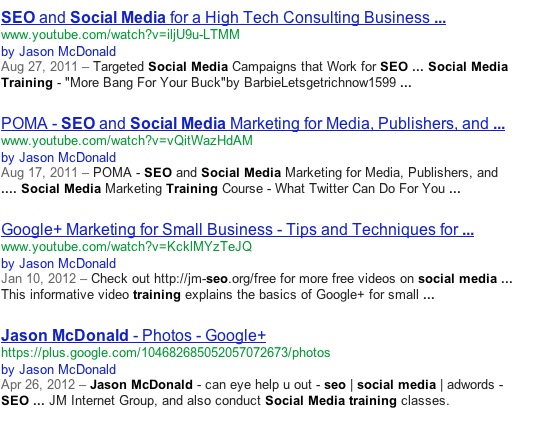
Click on “by (author name)” and the content created for the title link appears. Click on the “More by (author name)” link and you see a listing of annotations by that author as in the example below.

Google authorship of Jason McDonald


I like Google Authorship’s ability to give users a snapshot view of an author’s published work on the Web. It also gives authors the ability to add and share their work as they see fit.

Find Journalists & Share Information

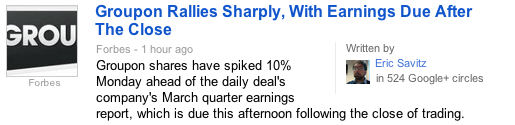
Articles written by journalists with a Google+ profile appear in Google News with their profile added. Lots of reporters writing for Forbes appear in Google News search lists.  By clicking on Eric Savitz’s name I learn he is the San Francisco Bureau chief for Forbes magazine. I see his email address and add him to one of my circles.

Google authorship journalist profile


Look for journalists who cover your topics. Build a relationship by sharing information on your area of expertise. You may be quoted in influential media and generate good publicity for yourself.

Weigh Your Influence With Google Social Reports

Authors need to create high quality content and be mindful of what audience they want to reach. Google recently bought PostRank and is rolling out social reports in Google Analytics. You can analyze traffic, optimize engagement, and make data-driven decisions. In Google+ you can also see what impact the content has had by using Google Ripples. It shows you who shared the content publicly, how it’s doing over time and other statistics.

If you want to get started here’s how to link your content to your Google + profile and get your content annotated in search results. Two different methods can be used depending on whether or not your Google + email address holds the same domain name as the site where your content appears.

These are just a few ways Google Authorship content can magnify your subject matter expertise.  Are you ready to share it?


2012 Content Strategy Trends for B2B

Business StrategyB2B companies will continue to rely on quality content in varied forms to differentiate themselves and their products during 2012. The website is still home base for most companies, but social media and branded content are augmenting their online presence. Marketing budgets are increasing in these areas. Companies are looking for business professionals who can develop content using a strategy that makes sense for their business.

To build relationships online B2B companies are adapting.

Websites

On websites prospects are looking for your location, contact information, what you do, a clear message, and easy interaction (click to chat?). Those not familiar with the company head for the About Us page first after reviewing the Home page. They also want to know who your customers are.

For 2012 you may want to consider using a lighter tone in your content to engage prospects. Be genuine and use simple language. Keep evolving with the design of your site to see what works best as your offers or strategies change.  Ways to add interest might include a blog, twitter feed, customer reviews/ratings or videos featuring your customers.

Social Media

For some B2B companies, social media is becoming a customer service outlet. It is on the social channels that they receive feedback and respond to customer inquiries and comments. Using social media this way can strengthen SEO ranking.

According to a recent survey of B2B marketers conducted by the Content Marketing Institute Twitter outdoes all other channels for content distribution with 74% of B2B content marketers using Twitter followed by LinkedIn (71%), Facebook (70%) and YouTube (56%).

Other content statistics from the survey show the following increases in usage:

  • Blogs: 45% increase
  • Case studies: 32% increase
  • Videos: 36% increase
  • Webinars/webcasts: 25% increase

Branded Content

A study conducted in 2011 by the Custom Content Council and  ContentWise shows that branded content (content produced by a brand that is driven by narrative, not commerce) represents more than 50% percent of the total marketing budget. Why use branded content? The most often cited reason was to educate customers. Branded content has lots of forms including guides with exclusive tips, books, videos, newsletters and blogs that address a particular topic of interest to an audience.

For 2012, more branded content will be used by marketers of all sizes. Nearly three quarters of respondents to the survey believe it is more effective than magazine advertising. Sixty-nine percent think it tops direct mail and public relations.

Content Strategy

Content strategists help companies create and position their content. Strategist Ahava Leibtag predicted that in 2012 more companies will rely on content curation (the vetting of information for customers), delivering and displaying content (think mobile devices) and integrating marketing and communications (social media people trained in customer service).

What becomes apparent is that in 2012 investing in quality content delivered by professional content providers is a good business strategy.

SEO Post Panda Puts Emphasis on Quality, Not Quantity Content

Big panda on rock

“Our goal is simple: to give people the most relevant answers to their queries as quickly as possible.” That’s how Google introduced its new Panda algorithm on the Official Google Blog written by Amit Singhal, Google Fellow, and Matt Cutts, Principal Engineer, in February 2011. They go on about the purpose of Panda……”it will provide better rankings for high quality sites—sites with original content and information…“ SEO aficionados looked at their toolkits and began to wonder.

On the official Google Webmaster Central Blog Amit offers guidance on what constitutes a quality site. Quality sites are trustworthy containing well-crafted content relevant to the audience’s interest. The questions below are the kind that Google staff pose when assessing the quality of a site. My advice for increasing your search rankings follows.

Trust

  • Would you trust the information presented in this article?
  • Does it carry authority from a knowledgeable author?
  • Is the site a recognized authority on its topic?

Who is researching, writing and overseeing your content becomes more important within the Panda paradigm. One way to build trust is to distribute original quality content throughout relevant networks online. You may gain inbound links that add to your authority.

Content

  • Is the content well edited? Does this article have spelling, stylistic, or factual errors?
  • Does the article provide original content or information, original reporting, original research, or original analysis?
  • How much quality control is done on content?
  • Does this article contain insightful analysis or interesting information that is beyond obvious?

Conduct a quality content audit. Review all of your pages and improve the content or remove low quality content. Eliminate duplicate content and keyword-stuffed pages. Hire an editor. Rely on people who can conduct an interview, research and write in a voice that conveys the proper tone, insight and interest. Create high amounts of content consistently.

Relevance

  • Are the topics driven by genuine interests of readers of the site, or does the site generate content by attempting to guess what might rank well in search engines?
  • Would you expect to see this article in a printed magazine, encyclopedia or book?

I thought these last questions interesting because they align with traditional publishing print practices. Imagine a magazine putting fluff on its pages to entice but not deliver to its audience or reading a published article with blatant factual errors. It wouldn’t be in business for long. Know your audience.

Google is now rewarding trustworthy, well-written, relevant content sites with top slots in its search rankings. Do you have someone you can depend on to deliver such content? Have you hired any new staff to address Panda’s quality issues?

How to Create (not copy) Quality Content

Here’s a simple question: Why is it so hard to create quality content?

Crowd with signs

Often, little attention is paid to what is being published. We see the same thing over and over again. Anyone can copy. If you want to generate better online leads and engagement, create custom content that expands upon your experience with the customers you serve. Harness what professional writers and researchers know about quality content. Then reach for new heights of creative achievement that differentiate you in a crowded market place.

Content isn’t just for websites. It is a part of your brand. It should offer a pragmatic promise not pie in the sky. Content moves across all your communications channels, including blogs and social media. Suppliers, manufacturers, distributors and buyers may depend on it. Use your existing body of knowledge to find creative solutions. Replace caution with curiosity. Listen to learn. Unleash your story telling ability.

Creativity includes process and technical ability. Below are some recent posts from Content For Biz that explore the process on how to create (not copy) quality content.

How to Convert Customer Knowledge into Content

How to Find Credible Sources for Articles, Blog Posts and Whitepapers

Writers Need Answers Before Content Creation Begins

Tell an Authentic Story

Worst Sentences Fixed

Why Tone & Mood Matter in Custom Content

Q&A Becomes a Custom Content Star for Mack Trucks

Not everyone is creative.  It is estimated that only 30% of the population falls into this category. In his book, A Whole New Mind, subtitled: Why Right-Brainers Will Rule the Future, author Dan Pink suggests that ingenuity and creativity will be more valued in the future because these traits cannot be computerized, outsourced or easily reproduced at a lower price.

Your content kettle should be stirred regularly. Add some spice. Where do you look for creative inspiration?