Foodservice Writers Review 2016 NRA Show Content

As foodservice writers we entered the 2016 National Restaurant Association Show with an eye on how well companies and speakers were communicating their message. Was it contextual, original, informative? Rather than rate what was good or bad we focused on the variety and substance of content. Here’s what we noticed from a foodservice writer perspective.

Trending Topics
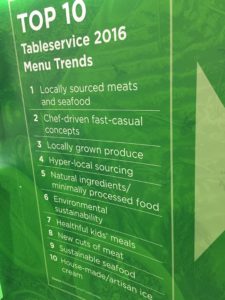
Trend topics for foodservicePaul Trotti, director of Menu Strategy at Chick-fil-A, talked about cleaner and healthier menus. Consumer behavior is driving this trend. Trotti’s presentation addressed both those who may be introducing new items on the menu and those who want to “clean” existing items. We recently created an advertorial on clean food for Marie’s and Plate magazine. Marie’s is launching a new line of salad dressings for the foodservice industry which are free of artificial flavors, colors, preservatives, HFCS, corn syrup or gluten. It’s a good example of a how a brand can align content to it’s products.

Fusion food has been around for awhile, but when the CEO of KOR Food talked about it the emphasis was not only on combining two cuisines but also growing practices, local ingredients and cooking styles. Trending topics are a good way to present thought leadership. Companies can show they are current and able to think creatively about what’s going on in the industry now.

Evergreen Topics

Developing expertise in an evergreen topic offers a wellspring of opportunity to develop content that continuously engages an audience. Anyone in the foodservice business knows restaurants face challenges when looking for reliable, skilled and committed workers. What are the latest recruiting and hiring tactics being used to meet the personnel challenge? T.J. Schier, president at SMART Restaurant Group, talked about how to develop a team of top performers. Her content addressed an ongoing concern and added value by providing steps the audience could take to meet their employment goals.

What’s Coming?

Introducing ‘next generation’ products, services and technology pulls interest. Gilbert Bailey, vice president at Beanstalk Engage, discussed how to manage restaurant data that’s being generated by guests in real-time. Marc Jacobs, partner and executive vice president at Lettuce Entertain You Enterprises, moderated a panel of speakers on the future of restaurant design. Panel discussions offer multiple perspectives on a single topic. As with any content, it is important to have a perspective.

Case Study

Shane O’Flaherty, national director of Hospitality and Travel
at Microsoft, and CEO and Co-founder of VMob, Scott Bradley, presented a case study that highlighted VMob’s intelligent personalization platform. This expert duo showed how collecting data from any source and combining it with existing customer data, can help restaurants tailor their content to a targeted audience and increase revenues. Case studies engage by providing a real-life, practical approach to solving challenges. They also provides two perspectives, that of seller and buyer. Case studies are a powerful way for sharing how-to, results-oriented content.

Demonstration

Exhibitor demonstrations were few and far between at the 2016 NRA show. There were many samples of food to try, but the process was rarely shown. With equipment , we did see Vollrath’s Instant Cut 5.0 being demonstrated by District Sales Manager Debbie Pasich. Here’s a quick look.


Demonstrations are an effective content form to create an experience for the audience and produce clarity around the product.

Celebrity

Celebrities draw crowds. Robert Irvine, Rick Bayless, Anne Burrell and others held signing sessions at the Show bookstore. Mario Rizzotti, Iron Chef America Judge & Italian Culinary Specialist, shared tips on tasting balsamic vinegar. In the proper setting, celebrity-based content boosts awareness and authority.

Live Interview
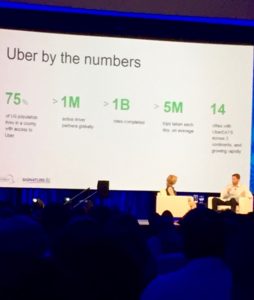
Jason Droege of Uber EatsDawn Sweeney, president and CEO of the NRA, conducted live interviews with three innovative foodservice leaders on Sunday. Restaurateur Kimbal Musk is creating Learning Gardens for grade school children across the country with 114 operating in Chicago. He talked about his experience with training farmers and becoming a trusted buyer of local food. Red Robin Burgers & Brews President Denny Post said the company has 5 million people registered in its loyalty group. The secret she said is, “Listening to our customers.” In his interview Jason Droege of Uber Eats, described how their logistics network of drivers went from moving people to moving food. The interview is a good content form for learning how people think and spread ideas.

Niche Markets

Everyone needs to eat, wherever they are. Laurie Maurino, departmental food administrator at the California Department of Corrections and Rehabilitation, talked about how they feed inmates for $3.45 per day. She touched on poignant challenges such as food waste, religious diets, and the use of fermented foods. When creating content about niche markets, a larger lesson can be shared.

Who and What Went Missing

Of the top largest foodservice distributors we saw only Sysco had a booth at the Show. Of the top five foodservice equipment and suppliers we saw only Edward Don & Co and Wasserstrom. The other noticeable absence was paper. Gone are the days when attendees filled bags with brochures, ads and catalogs. We observed increased reliance on the smartly designed NRA app vs the printed Exhibit guide.

Overall, the content shared at the 2016 NRA Show was abundant and relevant. Being foodservice writers, we know and appreciate that effort.

Why B2B Publishers Can Be Effective Content Marketing Partners

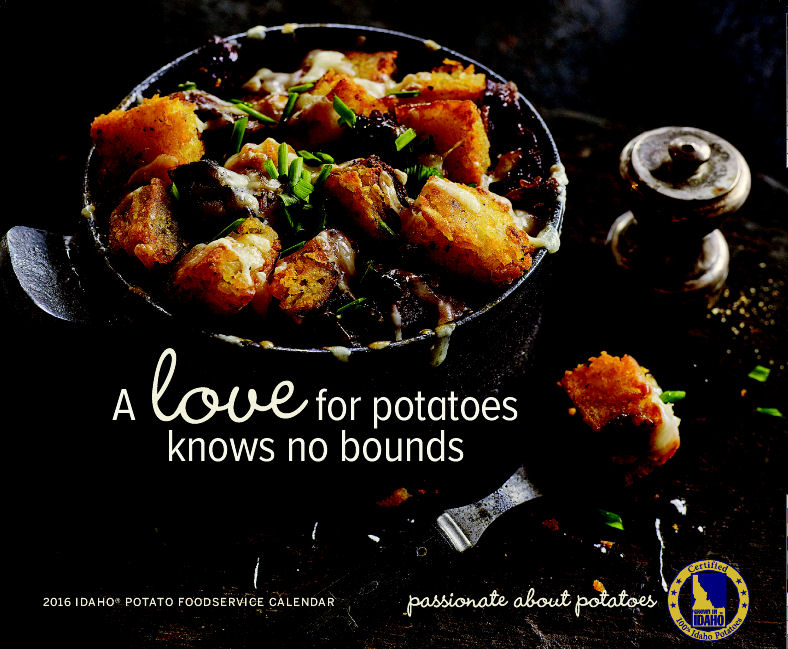
2016 Idaho Potato Chefs Calendar
Annual Idaho Potato Chef’s Calendar distributed through Plate magazine

Before going on your own to develop and distribute custom content you may want to explore a partnership with industry publishers. B2B publishers are in a unique position of knowing the audience you want to reach. They know what interests them, what their concerns are, and how to engage them.

Current topics, issues and trends are something publishers cover every day. You can use their arsenal of talented writers, designers and project managers to take your content to the next level. Get access to the markets you want to reach. Enhance your position in business-to-business markets and distribute your content efficiently.

Custom content can take many forms including branded or unbranded articles that are identified as advertorials, calendars, or supplements to name a few. A publisher who knows your audience and business objectives can offer insight on the type of content that will best engage readers.

Understand the publisher’s brand and mission

Custom content that appears in an industry website or publication places your business within a context of trust and knowledge. But first, you need to understand the publisher’s brand and its mission. It’s likely you are already familiar with publications serving your industry, but if you are new to the market, you can search online, or via SRDS to learn more.

Review the publisher’s magazine, website, and blogs. Read a few feature articles and look at the various sections. Online you can learn a lot about their mission by reading the About page. Contact the publisher and ask for a media kit to learn about their audience and reach. Review the editorial calendar to find topics they will be covering and when.

Identify your objectives for the custom content

Know what you want your content to do and how it will serve the intended audience. Here are several common objectives for custom content projects.

Position your product as on trend

Sunkist ran a series of advertorial articles in Plate magazine highlighting lemon-inspired desserts and cocktails. The articles ran opposite their advertisement. It provided additional editorial coverage for the Sunkist brand while describing creative uses of their product for Plate’s audience, professional chefs.

Position your company as a leader in the industry

To be viable, a sponsored article that addresses a new trend should include research data and quotes from respected industry leaders. In the food service industry clean label is something operators are just beginning to be impacted by. We recently gathered data, interviewed sources and wrote an article for a food service client on this topic to be published in an industry magazine.

Demonstrate product versatility

How are your customers using your product? Share their stories to show its versatility. That’s what the Idaho® Potato Commission does with its annual Foodservice Chef’s calendar. Each month highlights a chef’ along with their potato dish and recipe as well as industry events. It is distributed with the Nov/Dec issue of Plate magazine.

Affirm subject expertise

Share deep knowledge on a topic with custom supplements or whitepapers. These long-form content projects may be inserted and mailed with the B2B publisher magazine or featured online. As a pullout section in a print magazine, they provide readers with a unique reference and in-depth coverage of a topic.

Drive traffic to your website

B2B publishers may offer distribution of a custom e-newsletter directed toward your target audience. The same compelling content you find in print can be adapted for a custom e-newsletter, offering additional opportunities to measure results with special offers, downloads and increased web traffic.

Custom Content Continues to Work Long after the Published Date

Custom content has the advantage of being owned by you. This means you can share your custom publishing content with customers and prospects online and off. Its impact can go well beyond what appears in the publication. Use it in an eblast, for social media and as a blog topic. Extend its reach by distributing print content at trade shows and meetings or send a special mailing to your best customers.

Content for Biz is pleased to have media partners in the food service and construction industries who rely on us to develop custom content. We encourage you to take advantage of the unique role industry publishers have with their audience to make the most of your custom content.

Content Review of Inc 5000 Top Illinois Food & Beverage Companies

Content reviewGood website content supports growing businesses and their online audience. The Inc 5000 list ranks U.S.-based privately held, independent companies according to percentage revenue growth over a four year period. Revenue baselines are $200,000 for the initial year and at least $2 million in the most recent year. I looked at this year’s Inc top five food & beverage companies in Illinois to do a website content review.  Using a scale of 1 (needs work) to 5 (great job) my review is based on the following criteria.

Site design
Are there custom photos, engaging graphics, a usable layout and easy navigation?
Is there a visual strategy that supports the content?

Copywriting
Is the copywriting persuasive, trustworthy, concise and compelling?
Do I understand what they do, what products or services they offer, and how these will solve my problem and add value?
Does the tone fit the brand?

Social sharing
Can I share what I see with others through social media channels?
Can I engage with the company by signing up for a newsletter or commenting?
Are there testimonials or reviews I can access on the site?

“More” content
Has the company published articles, whitepapers or news releases?
Is there a blog that is updated regularly?
Are there videos, case studies or webinars where I can learn more?

Landing pages
Do they cover the topic/product well by answering my questions?
Do landing pages include a call to action and a method for capturing contact information?

Mobile friendly
Does the content display effectively on mobile devices?
Is it contextual content for the mobile user environment?

Following are the food and beverage company websites I reviewed.

Burry Foods, St. Charles, IL  (B2B)  ★★

The Burry Brand was established in 1936 and is most notably “the Thomas’, Boboli & Entenmann’s Frozen Foodservice Supplier!” Inc rates the company #7 nationwide in the Food & Beverage category and #12 in Chicago’s fastest growing privately held companies. My content rating based on the criteria above is 2. What I like is that they tell me right away what they do, what products they sell and to whom. A more robust design is needed. This is a static billboard type website with links that timed out while trying to call up new pages. There is no use of social media, a blog or “more” content.  Interaction is restricted to calling a phone number. The mobile version replicates the desktop. I like the Contact page because it includes a guarantee and phone numbers with names. They do establish trust and present their products in a forthright way.

Meatheads Several Chicago area locations  (B2C)  ★★★★

Ranked #15 in the Food & Beverage category this site is impressive. Rotating benefit headlines, mouth watering photography, easy navigation, social sharing buttons (“meatheads unite”), deals, community programs and customer focused content (“It pays to be a meathead”) create the right tone for content consumption. All the elements contribute to a brand experience. They provide calorie and nutrition information in a downloadable pdf format. I am giving them a 4. The site looks okay on a tablet but is hard to interact with on a smartphone. Their twitter and Facebook sites are active especially when they talk about Chicago sports teams. I’d like to see a live feed on the website and a blog.

Windy City Distribution, Warrenville, IL  ★★

“Chicagoland’s Best Beer Experience.” Distributing and marketing crafted beers, Windy City Distribution ranks #31 in the Food & Beverage category and #48 in Chicago. My content review puts them at a 2. The gray tone Home page makes me think of London, and I don’t recognize the background skyline as Chicago. The Home page copy reads more like an About Us page. The Sales Team landing page lists names rather than territories or titles.  No photos of the sales team are included. I’d like to see a case study, testimonial, or industry focused article/blog on the site. A video might work too.

Parts Town, Addison, IL. ★★★

Ranked #55 in Food & Beverage and #72 in Chicago, Parts Town sells parts online for commercial kitchens. Like a lot of e-commerce sites Parts Town overwhelms a visitor with unweighted content. By that I mean my eye doesn’t know where to go. I am ranking their content as a 3. A better page design layout is needed. The rotating headline text moves too fast for the average reader. They do have a good Facebook presence. There is a blog but it can’t be found via the site menu, so navigation is confusing. The Search by Parts could be a drop down menu rather than a listing. A body of text at the bottom that looks like a privacy or software usage agreement due to its small font and wide column. They do have a Resources page and a News page. Blending original photos with stock photos on the About page is confusing. The “Find Equipment Manuals” is a bonus content feature I like. Customers can find a product manual based on manufacturer, model and document type. They also provide a good mobile experience.

Growing companies need to manage their markets and their messaging. This content review of the Inc 5000 top Illinois food and beverage companies shows that progress is multifaceted.


What’s Behind the Drop in Blogging … Not the Results

Blogging is successful
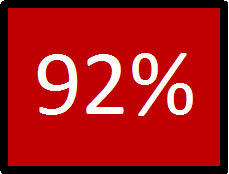
92% of survey participants said blogging was successful

“More Companies Quit Blogging, Go with Facebook Instead,” read the recent  USA Today Headline.

When I read this headline I made a note to myself to take a closer look at the University of Massachusetts study on which the USA Today article is based.

I was puzzled by the findings.  In 2010, 50% of the nation’s fastest growing private firms were blogging, up from 45% in 2009 and 39% in 2008. In this new 2011 study, the use of blogging dropped to 37%.

A note in the copy alludes to a changing mix in the Inc. 500 over the past two years.

“Changes in industry composition of the Inc. 500 over the past two years are reflected in our sample and have impacted our overall statistics in distinct ways. There has been an increase in companies providing Government Services (a result of some of the Obama initiatives). These companies increased their presence in the Inc. 500 in 2010 and again in 2011 and are less likely to use certain social media tools.”

Would an apple-to-apple comparison by industry would reveal the same kind of decline as the total sample?

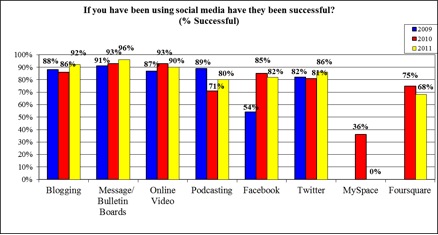
The death of blogging may be exaggerated.  Adding credence to this is the fact that in the very same study, blogging is rated as successful by 92% of those who utilize this tool. Among companies not currently using social media, 56% plan to add a blog.

Look who’s blogging.

Even with the recent decline, the nation’s fastest growing private companies are still “out blogging” the Fortune 500 by a considerable margin. Only 23 percent of the nation’s largest firms maintain a blog, compared to 37% of the  Inc. 500. Do an analysis within your industry. If your competitors aren’t blogging it could be a huge opportunity for you to increase your traffic and raise your rankings. If they are, you had better be prepared to step up your marketing efforts, because successful blogs are proven to generate traffic and sales leads.

Professional business blog writers can ease the burden of creating quality content  for your audience. Give us a call if you’d like to learn more.

Results of blogging and other social media 2011
Source: University of Massachussets Darthmouth


Social Media Lessons from Mom

Mom with grandaughterMy Mom’s not on social media yet, but she’s made a lot of friends in real life.  She hated growing up as an only child, so she had eight kids and hundreds of friends. Her social graces are second to none. These are the social media lessons I have learned from watching my Mom be SOCIAL.

1. Always carry a smile

My Mom loves to be around people and she always makes people feel welcome with a warm smile. The world is filled with bad news, but she fails to let it ruin her day. My friends always ask, “Has your Mom ever had a bad day?” I am sure has, but she’ll never let the world know. Keep your outlook positive in all your social interactions. Do your social media interactions show a  smile?

2. Give to others

When God blesses you with good health, a comfortable life and a wonderful family–or even just one of these things–you have a lot to be thankful for. Giving your time, talents and abundance is the best way to say thank you for what you have. People remember your kindness and they remember you. My Mom’s  in her eighties now and still driving people to the doctor, singing in the choir, and bringing communion to home bound parishioners. Now walking with a cane, she still never goes empty-handed anywhere.

3. Write a thank you note

Acknowledging the kindness of others is important. A handwritten note still stands out. Don’t forget to say thank you for comments (both positive and negative) and social media mentions.

4. Get out of the house

Nothing drove my mother crazier than kids moping around the house watching TV. Grab a friend and do something, or head out to a networking event. There’s nothing like meeting people face-to-face to  enhance your online networking and your life.

5. Share what you love

My Mom loves dessert and she always shares. That makes me happy. What do you love that you can share? There is value in sharing your work, and the work of others you admire.

6. Take time for friendship

My Mom always makes time for her friends. She has a high school club and a college club and a line dancing group and choir and they all plan regular get-togethers. Somehow she always finds the time. I wish I was better at this. Staying connected takes a little bit of work, but it’s worth it.

I hope you enjoyed these social media lessons I learned from my Mom. Happy Mother’s Day!