B2B Content Marketers to Increase Spending in 2012

Content Marketing GrowthIn a recent survey conducted by the Content Marketing Institute and Marketing Profs,  60 percent of B2B marketers said they would increase content marketing spending in 2012. On average, the marketers surveyed spent 26 percent of their total budget to content marketing initiatives.2012 Content Marketing Spending
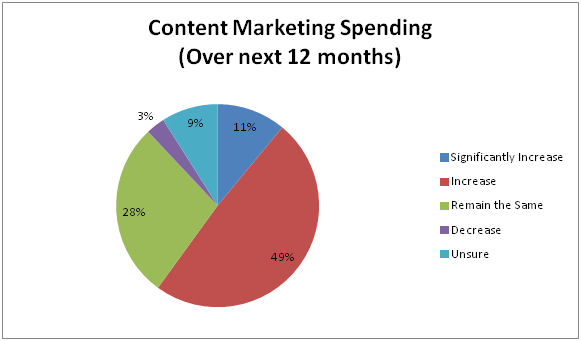
Source: Content Marketing Institute/Marketing Profs 2011

What’s fueling the increase? One reason may be increased effectiveness among marketers using various tactics. Effectiveness ratings for blogs saw a 45 percent jump in 2011, while those for videos increased 36 percent.  Case studies and webinars/webcasts also showed significant increases in effectiveness.

Overall, in-person events, webinars and case studies are seen as the most effective strategies (more than seven out of 10 respondents ranked these as effective). Social media was viewed as the least effective strategy, but scores improved significantly from 2011. Sixty-one percent more marketers ranked it effective in 2011 vs. last year.

More B2B Marketers Outsource Some Content

With greater content needs, more marketers are outsourcing. Sixty-two percent of respondents use a mix of in-sourced and outsourced content, up from 55 percent in 2010. Outsource only strategies are rare at 4 percent.  On average 25 percent of the content creation budget involves outsourced resources.

The content marketing strategies on the upswing are blogs (+11%), video (+11%) and whitepapers(+8%). While some tactics such as print magazine, print newsletters and ebooks showed declines.

As content marketing grows, marketers are developing new ways to measure effectiveness. While measuring web traffic (58%) and sales lead quality (49%) are still the most popular measures, SEO ranking jumped 12 percentage points in just a year with 40 percent of respondents using it to measuring results.

The survey was mailed electronically to a sample of B2B marketers from among members and subscribers to MarketingProfs and the Content Marketing Institute. A total of 1,092 responded worldwide with the majority based in North America. The respondents represent a range of functional areas, industries and company sizes.

How does this compare to your 2012 plans?

For Better Website Content Focus on Market Segments

Restaurant RibsWhen we think of our products and services generically, our “stories” become less interesting and lack detail. Instead, position your company relative to the needs of a specific market. I recently reviewed the website content of a credit card fulfillment company serving a wide variety of industries – including retail, foodservice, small business and non-profits. While there was a unique page geared to each audience, the majority of the website content failed to address any specific industry concerns. When it comes to website content, problems become opportunities. Think of the problems that customers are looking to solve.

Instead of generic credit card processing, think credit card processing for restaurants. The National Restaurant Association is currently lobbying to reduce the fees charged by credit card companies, which can amount to the third largest expense behind food and labor.  Here are some website content ideas I suggested to drive traffic and convert visitors into buyers:

1) “Know the Hidden Costs of Payment Card Processing for Restaurants,” could be a downloadable whitepaper while “Three Ways to Save on Credit Card Processing,” might be the subject of a blog post that relates specifically to the highest cost drivers for restaurants.

2) A website calculator would allow restaurant operators to estimate their monthly charges and compare it to their current provider.

3) Updates on pending credit card legislation could be posted on the company blog, along with the opinions of restaurant industry leaders.

The restaurant industry is also among the most vulnerable to credit card fraud. Website content addressing data security should showcase how problems occur and what restaurant operators can do to better protect customer data. Solutions should go beyond technology. Here are some website content ideas related to credit card fraud in the restaurant industry:

1) Restaurant credit card fraud news would detail recent breaches within the industry and suggest the implications for restaurant operators.

2) A whitepaper or webinar, “Why PCI Compliance Isn’t Enough,” would provide practical training solutions for restaurant operators.

Lastly, blog posts and articles could be created to address how operators can increase customer satisfaction and generate more revenue by embracing new technologies. Case studies would showcase how operators are increasing sales through virtual terminals and credit card payments through mobile devices.

The idea of all of this, of course, is to provide website content that is more relevant to your customers. As much as your solutions may work in a variety of industries, it makes sense to provide industry-specific context that will make your stories interesting, believable and searchable.

How does your website content address the needs of a specific industry?