Content Strategy: A Recipe for B2B Marketing Success

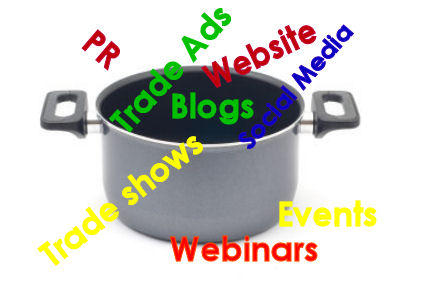
stock pot with marketing mixAre you overwhelmed by the number of touch points you have with customers?  The marketing mix for many B2B companies today looks like a recipe with an ever-increasing number of ingredients. Imagine the pot is your company. The protein for your recipe is your website and without it, your marketing lacks power. Trade magazines, trade shows and traditional public relations form a base; add blogs;  mix in Facebook, LinkedIn, Twitter and You Tube; sprinkle in custom events, networking, webinars, and mobile. It’s either a recipe for success or a recipe for disaster.

Before the Internet, you knew the recipe for B2B marketing success fairly well. Now the recipe has become far more complicated. You can’t just throw in more ingredients and expect it to taste good. You need to think about what each element of the marketing mix can contribute because time and money are limited. You need to think about what customers are looking for and how they engage in each of the platforms.

In the old days a prospect may have picked up the phone and called a vendor to help him in the buying process.  Today buyers conduct much of their preliminary research online.  Your customers are going to find the information they need from someone. How will you help them? What can you provide that will be useful? How will you stand out in the crowd? How will you build trust? Where will they look for this information?

Here’s a way to simplify the process:

1)      Determine Who

Who do you want to reach? If there are multiple audiences you’ll need separate strategies. Learn as much about them as you can.

2)      Determine Your Objectives

Are you after sales leads or brand awareness? Are you trying to establish credibility or educate customers?  Choose the “ingredients” of your marketing mix based on your objectives.

3)      Determine  What

Content should also be aligned with objectives. What can you show, what can you say, what have you done, that will help you accomplish your objectives? How will you show it, how will you say it, how will you communicate it on each of your selected channels? This is content strategy.

Some B2B marketers are probably moving too quickly into new media, while others aren’t moving quickly enough. But whether you are just beginning to embrace it, or have already jumped in, taking the time to develop a content strategy will help ensure your success.

Coming soon… Content for Biz will offer a complimentary B2B content strategy worksheet for all our subscribers. Sign up today be sure you don’t miss it.


Six Things You Can You Learn from B-2-B Publishers

You’ve heard that everyone is a publisher now, so what can you learn from successful publishers.

B2B publishers have made a living off their ability to deliver  audiences, initially through print and now online. Long before there was SEO, publications knew that great content would bring them loyal readership. Publishers continue to be  go-to sources for information on industry trends, news,  leaders, research and best practices. And with more competition for a reader’s time from all sorts of sources,  today’s leading publishers are working harder than ever .  The draw is still great content. However, many magazine websites have been transformed from online versions of the  print product, into  rich sites that fully embrace multimedia and  social networks.

Now that you are trying to win over your own audience online with content, it makes sense to try and learn what you can from the pros.

1) Keep the needs of the customer/reader first and foremost.

It’s not about you and your company, it’s about your customer.  What are their problems and how can you solve them.

2)Be fair and factual.

Your audience knows you are trying to sell something, but that doesn’t mean you can’t be a credible, reliable, source of information. Stick to the facts and avoid “ad-like” promises and sales jargon.

3)Hire professional writers.

Subject matter experts who can also write are few and far between. They are usually too busy with other jobs to write. Instead of trying to rely on them, hire a professional writer who knows how to pull the information from your sources  and present it in a useful, usable and interesting format.

4)Keep a schedule.

As a reader, I  know when my favorite industry publication will arrive each month, and I look forward to it. The same is true of my InBox.  Whether you decide to publish content on a daily, weekly or monthly frequency, stick to a schedule.  Be aware that there’s a direct correlation between frequency of content and website visits.

5) Look for the best way to tell a story.

Does the story lend itself to video, radio or text?  PMQ’s Pizza TV is used to demonstrate a technique for rolling  a pizza crust over the shoulder. It just wouldn’t be the same in print.

6)Add value with social sharing.

Today’s publishing websites include more ways for audiences to connect and share ideas with each other. PMQ Pizza Think Thank forum is a reminder that your customers and prospects can create your content.  On techrepublic.com, social stats are front and center, helping the audience find  useful content fast.

As a content marketer you need to know how to succeed in publishing. Examine your favorite industry magazine websites with a fresh eye. What do you like about them?  How can you use that information to  engage your audience? What do you see on consumer magazine websites that could translate to B2B?

Q&A Becomes a Custom Content Star for Mack Trucks

BulldogWhat questions do potential customers have about your B2B brand? Mack Trucks got it right when they added a section to their website called “Talking SCR.”  SCR (Selective Catalytic Reduction) is a new technology that Mack employed to meet stricter emissions regulations. The change had truck owners worried about how SCR technology would affect fuel economy, costs and maintenance.

The SCR Talks section allows website visitors to submit questions via email to Dave McKenna, director of Powertrain sales and marketing. Questions and answers are then posted on www.macktruck.com. The appeal of the section is in the authenticity of both the truckers and McKenna.

While McKenna is straightforward in presenting the facts, his passion and enthusiasm for Mack shines through, especially when he shares the news of a sale.  He deals with competitive questions head on. Customers show genuine appreciation for the information. Says one customer, “Thanks for all the great information and for taking your time to answer our questions – it’s invaluable in understanding the real world applicability of these technologies.”

Information that your audience finds invaluable is powerful. The opportunity to ask a question and get a personal response is simple, yet effective in building brand loyalty. Shared on the Internet, the information becomes a benefit to the entire Mack Truck community and a positive force for the brand.

In an interview with B2B for its “10 Great Websites” feature article, Sharon Shuman, director of e-business for Mack Trucks, called SCR Talks one of the most popular areas of the website.

What questions are your customers asking? Who can best answer them? Mack Trucks offers proof that Q&A can become quality custom content–useful information  that can drive traffic and build loyalty among your audience.

Tell an Authentic Story

Powhatan Cooking Demonstration at Jamestown Settlement

I spent some time in Williamsburg, Va., last week and we visited the nearby Jamestown settlement and Powhatan Indian village exhibit.  There was something about Caucasians playing the part of the Indians that left me thinking about authenticity, or the lack of it.

Case studies can provide compelling content, but authenticity is key.  Potential customers want to read real stories, and if your copy sounds like a sales pitch, they will quickly move on.

An authentic story begins with an interview that goes beyond the basics.  Here are some of the methods and questions I have found helpful in capturing an authentic and compelling story from a business owner, customer  or subject matter expert.

Before the Interview

Learn as much as you can about the business of the person you are interviewing.   Check their profile on Linked-In, view the company website, make a personal visit to their business if possible. By doing this you will avoid the obvious questions, become familiar with the industry-specific language, and identify topics for discussion.

Begin with some small talk and set a friendly tone. Let them know you will provide them with an opportunity to review their comments. This serves to relax the person being interviewed. If someone is rushed, offer to call back when they are not distracted by pressing business problems.

During the Interview

A vivid description of the customer and their problem will engage readers who will identify with the story.  Ask questions in a non-threatening way.  Don’t just run through a predetermined list of questions (although it’s a good idea to prepare questions in advance). Show genuine interest and ask follow up questions.  And if the person goes off on a tangent, be patient.

Ask about their responsibilities and their biggest work challenges. Ask how the product or service fits into the grand scheme of their job or product. Ask what life was like before they found a solution. If they are a business owner, ask how they got into the business.  Uncover what the true pain points were. Get all the details that will create an authentic story.

If you are a marketer, you must take off your marketing hat and think like a journalist, asking the who, what, when, where and why questions. Ask them to compare how they do things now, vs. how they did things before. Ask how they came to find out about the solution. Ask what they were apprehensive about in choosing a supplier and how they were able to alleviate these doubts. Ask about the other options they considered and why they didn’t choose them. Ask what they would do differently, if they had to do it over again. Avoid presenting a completely one-sided view.

Ask how the solution met or exceed their expectations. Focus on customer service issues as well as benefits of the product. Ask about any critical timing or delivery issues. Ask if there were any unexpected benefits or rewards. Ask if any problems came up and how they were resolved. Find out if there was positive feedback from customers, sales or the management. Are there any quantitative measures of success? If so, find out what those numbers really mean to the business.  Were they able to increase profits or reduce costs? Facts and figures are an essential component of a convincing case study.

After the Interview

When writing the case study, use quotes, facts and details gleaned from your interview to add authenticity and personality. Make your story  easy to read and skim online through with good use of subheads and call-out quotes.  Don’t forget to include your keywords and phrases.

I like like this case study from Trimble. The details and conversational language helps to make it both authentic and readable.

What are some other ways to add authenticity to your website content?

With Listening, Comes Clarity

headphones and keyboardBefore you write a word of content for your B2B website, listen to your customers.

Carve 30 minutes out of your schedule,  leave your preconceived notions about your business at the door and call a customer. Instead of worrying about selling something, focus on listening.  Listen to their questions and answer them.  Hear their problems and ask yourself if you have a solution.  Ask about the process they went through before they purchased. Ask how they felt afterward. Ask what motivates them to buy. Ask what you could do better.  Ask them to describe your products and services. Ask what makes your business stand out from competitors.

Take notes.

When we do this for our clients, what we need to say and how we need to say it becomes much clearer. Unlike people close to the business, customers won’t tell you everything about your product, but they will tell you what’s important. And that’s what is most helpful to a writer.

You have seconds to communicate your message and you must be clear. You cannot try to communicate too much or people will shut down. Visitors won’t bother to call and ask a question. They will move on to another website.

Don’t let language be a barrier. Use their language not yours. Worry less about industry experts writing content, and worry more about providing clear and understandable content.

What would you like to see on Content for Biz? I am listening.