Why B2B Publishers Can Be Effective Content Marketing Partners

2016 Idaho Potato Chefs Calendar
Annual Idaho Potato Chef’s Calendar distributed through Plate magazine

Before going on your own to develop and distribute custom content you may want to explore a partnership with industry publishers. B2B publishers are in a unique position of knowing the audience you want to reach. They know what interests them, what their concerns are, and how to engage them.

Current topics, issues and trends are something publishers cover every day. You can use their arsenal of talented writers, designers and project managers to take your content to the next level. Get access to the markets you want to reach. Enhance your position in business-to-business markets and distribute your content efficiently.

Custom content can take many forms including branded or unbranded articles that are identified as advertorials, calendars, or supplements to name a few. A publisher who knows your audience and business objectives can offer insight on the type of content that will best engage readers.

Understand the publisher’s brand and mission

Custom content that appears in an industry website or publication places your business within a context of trust and knowledge. But first, you need to understand the publisher’s brand and its mission. It’s likely you are already familiar with publications serving your industry, but if you are new to the market, you can search online, or via SRDS to learn more.

Review the publisher’s magazine, website, and blogs. Read a few feature articles and look at the various sections. Online you can learn a lot about their mission by reading the About page. Contact the publisher and ask for a media kit to learn about their audience and reach. Review the editorial calendar to find topics they will be covering and when.

Identify your objectives for the custom content

Know what you want your content to do and how it will serve the intended audience. Here are several common objectives for custom content projects.

Position your product as on trend

Sunkist ran a series of advertorial articles in Plate magazine highlighting lemon-inspired desserts and cocktails. The articles ran opposite their advertisement. It provided additional editorial coverage for the Sunkist brand while describing creative uses of their product for Plate’s audience, professional chefs.

Position your company as a leader in the industry

To be viable, a sponsored article that addresses a new trend should include research data and quotes from respected industry leaders. In the food service industry clean label is something operators are just beginning to be impacted by. We recently gathered data, interviewed sources and wrote an article for a food service client on this topic to be published in an industry magazine.

Demonstrate product versatility

How are your customers using your product? Share their stories to show its versatility. That’s what the Idaho® Potato Commission does with its annual Foodservice Chef’s calendar. Each month highlights a chef’ along with their potato dish and recipe as well as industry events. It is distributed with the Nov/Dec issue of Plate magazine.

Affirm subject expertise

Share deep knowledge on a topic with custom supplements or whitepapers. These long-form content projects may be inserted and mailed with the B2B publisher magazine or featured online. As a pullout section in a print magazine, they provide readers with a unique reference and in-depth coverage of a topic.

Drive traffic to your website

B2B publishers may offer distribution of a custom e-newsletter directed toward your target audience. The same compelling content you find in print can be adapted for a custom e-newsletter, offering additional opportunities to measure results with special offers, downloads and increased web traffic.

Custom Content Continues to Work Long after the Published Date

Custom content has the advantage of being owned by you. This means you can share your custom publishing content with customers and prospects online and off. Its impact can go well beyond what appears in the publication. Use it in an eblast, for social media and as a blog topic. Extend its reach by distributing print content at trade shows and meetings or send a special mailing to your best customers.

Content for Biz is pleased to have media partners in the food service and construction industries who rely on us to develop custom content. We encourage you to take advantage of the unique role industry publishers have with their audience to make the most of your custom content.

Is Your Content Marketing Program Ready For 2014?

NewYearhat


Below is a short list of what content marketers will need for 2014.

==> A content strategy that identifies audience, messages, timing, tone and channels. A strategy is designed to meet both project goals and audience interest. How will you use short and long-form content?

==> A schedule in the form of an editorial calendar that includes topic, writer, sales stage, keywords and due dates. The calendar keeps you focused.

==> Distribution channels that extend your content reach. Think about how you will deliver video content and slides, or sponsored content through trade publications.

==> Multimedia format to freshen more than your visual appeal. Go beyond the infographic to include sound, audience interaction and demonstrations.

==> Technical knowledge that leads to measurable results. Use your data to target, segment and personalize your content. Know what’s working and what is not.

If you are having trouble wrapping your arms around this short list, we at Content For Biz provide content writing services that will help you have a fabulous new year. What’s on your short list?

Like Volkswagen, Tell A Story of Why You Do or Don’t Change

product storytellingSome people don’t like change. With so many iterations of products and services customers are likely to get confused. Whether you do or don’t change, you want them to feel good about it, right? This deserves a story, not a spec sheet.

In 1960, Volkswagen ran a print ad that tells the story of why they made a minor change to their classic Beetle design. The appearance of the car had not changed for many years. They brought in a world famous Italian auto body designer and asked him what changes he would make.  He recommended a larger rear window. So they made the rear window larger. The company assures the customer that they don’t change to be different, just better.

Build Product Legacy

What functional or design improvements have you made and why? Let your customers know. It is impressive that Volkswagen would seek the advice of a famous designer. Whom do you seek advice from? Quote the source. If it’s not apparent why you took the advice, explain. If you don’t change your product, describe why not. Be sure to include a narrator in your story. Someone the customer will identify with. In telling stories you create a legacy for your product. With legacy comes loyalty – especially for people who don’t like change.

Keep Marketing Content Fresh

To this day Volkswagen retains the classic Beetle design. Yet even back then, they changed their marketing content often.  Ads focused on interchangeable parts, functional improvements, economy of costs, and consistency of quality.  Beautiful and playful photography enhanced the ads appeal.

Look at Volkswagen’s television ad for Super Bowl 2013 to see how they are still giving people something to smile about. It’s a great example of product with attitude. In the modern era, a Stories page on their website allows people to find a story by topic or add one of their own. Any company can do this on their website and social sites. It’s a great way to see how people view your product both emotionally and logically.

Whether your product is the Volkswagen of your industry or not, engage your customers by telling the story of why you do or don’t change. If you don’t know of any stories, we can uncover them. Learn more about our content writing services.


A Good Content Writer Takes the Extra Steps

A good content writer takes the extra steps

Do you have time for the extra steps it takes be a good content writer?

I think writing for the web requires more discipline than writing for print. First of all, website visitors don’t read, they scan, and you have only seconds to capture their interest.  You need to make your point quickly. At the same time search engines aren’t all that forgiving. If you don’t include the right keywords, or use the right code, your content may as well be invisible.  Being a good content writer means you take that all into account. You take the extra steps to ensure high quality content that will drive online results.

Step 1.  Research

Effective content writing requires putting yourself in someone else’s shoes.  A content writer shouldn’t guess at topic areas to cover, they should research them. They should interview sales and service people to find out what questions people ask. A good content writer checks Google adwords and asks to review website analytics to see what problems your customers and prospects are trying to solve.

Step 2: Originality

The Internet has made it incredibly easy to see what your competitor’s are writing about. But if you want to stand out online your B2B brand needs its own voice. Seek originality in both content and content delivery.  A good content writer asks, ‘What hasn’t been done before?’ and ‘What’s the best way to deliver the information? ‘

Step 3.  Editing

On a small computer screen or phone, even the shortest of paragraphs can seem long. Rather than read it, your customers and prospects will move on. A good content writer is diligent in keeping sentences and paragraphs short.  They weed out unnecessary words and break up long lists with bullet points. A good content writer reads copy aloud to identify awkward text that doesn’t flow.

Step 4.  Keyword and Word Selection

A good content writer  understands the importance of keywords and using the language of the audience. They start with a specific keyword and then write copy to support it.  To do otherwise is to invite awkwardness.  Words are chosen carefully.  Industry jargon is avoided to satisfy the needs of both humans and search engines.

Step 5.  Proofreading

A typo or misspelling is embarrassing. It is easy to see the mistakes of others, but more difficult to spot your own. Good content writers have a system for proofreading their work to catch grammatical errors, omissions and misspellings.

These extra steps inspire and ensure quality content.  It’s one more interview, one more read through the copy, one more ounce of effort that separates a good content writer from a mediocre one. It takes time that you might not have.

How do you find the best writers?

B2B Content Marketers to Increase Spending in 2012

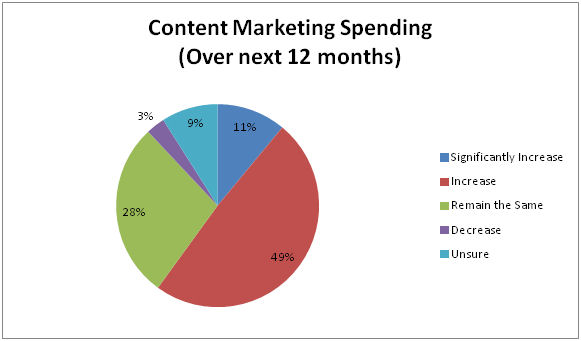
Content Marketing GrowthIn a recent survey conducted by the Content Marketing Institute and Marketing Profs,  60 percent of B2B marketers said they would increase content marketing spending in 2012. On average, the marketers surveyed spent 26 percent of their total budget to content marketing initiatives.2012 Content Marketing Spending

Source: Content Marketing Institute/Marketing Profs 2011

What’s fueling the increase? One reason may be increased effectiveness among marketers using various tactics. Effectiveness ratings for blogs saw a 45 percent jump in 2011, while those for videos increased 36 percent.  Case studies and webinars/webcasts also showed significant increases in effectiveness.

Overall, in-person events, webinars and case studies are seen as the most effective strategies (more than seven out of 10 respondents ranked these as effective). Social media was viewed as the least effective strategy, but scores improved significantly from 2011. Sixty-one percent more marketers ranked it effective in 2011 vs. last year.

More B2B Marketers Outsource Some Content

With greater content needs, more marketers are outsourcing. Sixty-two percent of respondents use a mix of in-sourced and outsourced content, up from 55 percent in 2010. Outsource only strategies are rare at 4 percent.  On average 25 percent of the content creation budget involves outsourced resources.

The content marketing strategies on the upswing are blogs (+11%), video (+11%) and whitepapers(+8%). While some tactics such as print magazine, print newsletters and ebooks showed declines.

As content marketing grows, marketers are developing new ways to measure effectiveness. While measuring web traffic (58%) and sales lead quality (49%) are still the most popular measures, SEO ranking jumped 12 percentage points in just a year with 40 percent of respondents using it to measuring results.

The survey was mailed electronically to a sample of B2B marketers from among members and subscribers to MarketingProfs and the Content Marketing Institute. A total of 1,092 responded worldwide with the majority based in North America. The respondents represent a range of functional areas, industries and company sizes.

How does this compare to your 2012 plans?