A Good Content Writer Takes the Extra Steps

A good content writer takes the extra steps

Do you have time for the extra steps it takes be a good content writer?

I think writing for the web requires more discipline than writing for print. First of all, website visitors don’t read, they scan, and you have only seconds to capture their interest.  You need to make your point quickly. At the same time search engines aren’t all that forgiving. If you don’t include the right keywords, or use the right code, your content may as well be invisible.  Being a good content writer means you take that all into account. You take the extra steps to ensure high quality content that will drive online results.

Step 1.  Research

Effective content writing requires putting yourself in someone else’s shoes.  A content writer shouldn’t guess at topic areas to cover, they should research them. They should interview sales and service people to find out what questions people ask. A good content writer checks Google adwords and asks to review website analytics to see what problems your customers and prospects are trying to solve.

Step 2: Originality

The Internet has made it incredibly easy to see what your competitor’s are writing about. But if you want to stand out online your B2B brand needs its own voice. Seek originality in both content and content delivery.  A good content writer asks, ‘What hasn’t been done before?’ and ‘What’s the best way to deliver the information? ‘

Step 3.  Editing

On a small computer screen or phone, even the shortest of paragraphs can seem long. Rather than read it, your customers and prospects will move on. A good content writer is diligent in keeping sentences and paragraphs short.  They weed out unnecessary words and break up long lists with bullet points. A good content writer reads copy aloud to identify awkward text that doesn’t flow.

Step 4.  Keyword and Word Selection

A good content writer  understands the importance of keywords and using the language of the audience. They start with a specific keyword and then write copy to support it.  To do otherwise is to invite awkwardness.  Words are chosen carefully.  Industry jargon is avoided to satisfy the needs of both humans and search engines.

Step 5.  Proofreading

A typo or misspelling is embarrassing. It is easy to see the mistakes of others, but more difficult to spot your own. Good content writers have a system for proofreading their work to catch grammatical errors, omissions and misspellings.

These extra steps inspire and ensure quality content.  It’s one more interview, one more read through the copy, one more ounce of effort that separates a good content writer from a mediocre one. It takes time that you might not have.

How do you find the best writers?

What Writers Can Do to Make Online Content Findable

In print, writers use headlines and subheads to help readers quickly decipher what a page is about. Online, hierarchical XHTML tags serve the same purpose, only with an added twist. They let search engines know what a web page is about. As a content writer you can help your website content get found, by ensuring it is coded with the right hierarchical XHTML tags: <title> <h1> <h2> starting with the most important <title> tag and working down.

<Title> Tags Are Most Important to Search Engines

Title tags are the most important element on the web page for search engines.  Search engine robots pull the contents of your <title> tag from your page and identify it as the most important information in the search result. Since many potential visitors won’t know your company name, it is important to include a keyword FIRST, in the title tag, not your business or blog name.

Use <h1> Tags for Headlines and Blog Post Titles

The <h1> tag is another important tag that helps tell the search engine what the page is about. For the greatest effect, a content writers should include specific information about your web page in <h1> tags. Consider putting a tagline in an <h1> tag on your home page, but lower down in the hierarchy on interior pages. Use an h1 tag for blog post titles.

Use <h2>Tags for Subheads

Content writers break up blocks of  text with subheads to make the reading  easier and more inviting. Placing subheads  in an <h2> tag provides an opportunity for the search engines to learn more about what is on your page. When possible incorporate keywords.

In WordPress, sidebar headlines are typically given an <h2> tag, but depending on their relevance to search, you may want to move them down the hierarchy.

To maximize your website for search engines, write each web page with a clear focus and use the hierarchy of tags to guide the search engines to your content. To see how your page is currently coded view your source code (right click on the web page and click “view source”) and evaluate how you might better optimize your  blog or website.

In this example below, Itasca Construction uses the  “Commercial Builder|Chicago, Illinois”, as the <title> tag for the company’s home page instead of the company name. If you are providing copy to a webmaster, clearly label the text you want for the <title>, <h1> and <h2> headings.

Google Results for Commercial Builders+Chicago
The title tag is “Commercial Builders|Chicago, Illinois”

Did you find this information helpful?

How to Find a Web Content Writer You Like

web content writerMore than eighty million results. That’s what turned up on Bing when I entered the term content writer. No wonder you feel overwhelmed looking for a content writer. When you work in publishing, writers come to you, but for business marketers and business owners it isn’t easy to find the right person. How do you find someone who knows your business or is willing to invest the time to learn? How do you find a content writer who understands what you want to accomplish? How do you find someone who can deliver web content that will raise your company’s search engine rankings, increase your traffic and generate leads?

Here are five ways you can separate the good content writers from the bad.

1)      A content writer should have credentials.

Look at where a content writer’s work has been published.  Are the publications or websites familiar to you? Is the content writer focused on the needs of consumers or business? Who are their clients? I would also look for some professional affiliations that identify their areas of interest such as the Construction Writers Association or the  International Foodservice Editorial Council .

2)      Writing should be clear, concise and understandable.

Check out the content writer’s examples of web writing.  Is the copy clear, concise and understandable? Does the writer offer a benefit, answer the visitor’s questions and include a call to action? Is the writing free of spelling and grammatical errors?  Can the writer provide examples of blog posts, email newsletters and other online marketing initiatives?

3)      A content writer should be creative.

Evaluate web writing samples, and ask for the submitted Word files for the project. You want to find out how much editing was required.  Does the content writer make an effort to draw the reader in with a creative headline or lead? Does the content writer offer a unique or unusual perspective?  Is the website content unique, or does it look very similar to other competitors in the space?

4)      A content writer needs to understand SEO.

Does the content writer have experience in writing copy that is optimized for search engines? Does the content writer research keywords and key phrases for your business? Ask what traffic results the writer achieved?  What does the writer’s own website look like? Is it well written and easy to navigate?

5)      A content writer should be easy to work with.

Good content writers become invaluable when they are responsive, timely, and take the initiative to develop original content ideas.  They welcome your feedback and suggestions.  A good writer makes a concerted effort to accommodate your schedule and meet tight deadlines. Ask other businesses, agencies, web developers, marketing and PR professionals in your industry for recommendations. Talk with prospective writers and their clients. For a long-term assignment or if you have ongoing writing projects, I think it’s fair to ask for a small writing sample geared towards your specific needs.  Do your due diligence and you will find a writer you like to work with.

And don’t forget to call Content for Biz to discuss your content writing needs.

3 Best Sites for Tracking Content Trends

Content writers and industry professionals need to track trends to stay current, find topic ideas to write about and learn what terms people are using to search the Internet. You can gage what keywords and topics are trending outside and within your industry, today, last month, and annually using these three best sites for content trend tracking. This is a routine I find effective as a content writer and communications strategist.

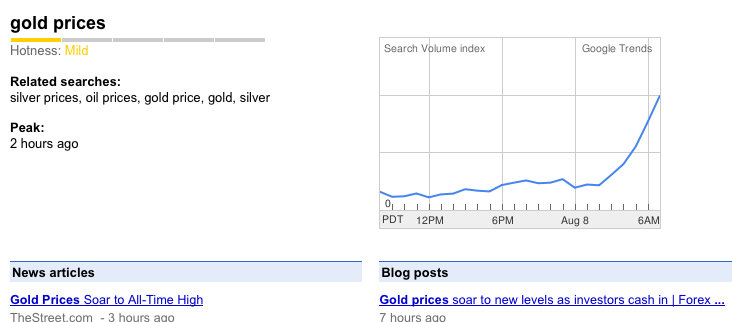
First, check out Google Trends. Early this morning some trending topics were “gold prices,” “Nestle” and “Stephen Hawking.” The price of gold is surging to new heights. If you are in the finance world, adding the words “gold prices” to your blog post,  e-newsletter, or social media titles today will likely increase your traffic.

Google trends page

You can change the date and see what the search trends were any day in the last year. Lots of people search for the Dow Jones Industrial Average using “djia.” Use the right abbreviations/terms and you have a better chance of connecting with your audience. Google Trends is updated every hour. You can subscribe to “Hot Trends” through an RSS feed.

Trends Buzz page

Trends Buzz gives a great overview of the most searched words at the moment on Google, Yahoo, Twitter, Alexa, Blogpulse, Wordtracker, Wikipedia and more.  Clicking on the term link opens up a listing of content on the subject.

Alltop pageMy other favorite site for reviewing trends and topics is Alltop. The home page has popular articles by good writers. You can search by industry or keyword to get all the most searched for topics. It’s sometimes hard for me to get off this page. It shows how great headlines draw reader interest.

Use these sites for tracking content trends and audience patterns emerge. Understanding how popular content fluctuates can help you plan your content accordingly. Knowing what words people use to search and the power of a good headline are added benefits of monitoring these 3 best sites for tracking content trends.

How are you using Internet trends to drive traffic to your site?

Is Your Content Writer Asking the Right Questions?

question markDo you have the right content writer for the job? The questions a content writer asks will tell you a lot about a writer’s ability to drive traffic to your site and convince prospects to take the next step.

1)      Do they ask for the objectives of the website or of each page?

Without clear objectives it will be difficult for a content writer to satisfy your needs.

2)      Do they ask for the keywords and keyphrases you are targeting for your business?

If your writer doesn’t ask about keywords it’s a clear sign they don’t know much about search optimization . Without the right keyword and keyphrases, your firm’s content won’t improve search results.

3)      Do they ask for the names of clients to contact, to learn more about your product or services?

Good content writers know that the most powerful testimony for any product or service comes from the customer.

4)      Do they ask for the names of product or service experts to contact?

Asking for additional resources to contact demonstrates a writer’s willingness to delve deep to get a firm understanding of the product or service.

5)      Do they ask for the names of your competitors?

A good content writer will ensure that your website content is unique. Checking out the competition is smart strategy.

6)      Do they ask you to describe the tone and feel you want for your site?

Will it be informal, formal, or humorous? A good content writer saves time by finding out up front.

7)      Do they ask for the names of websites you like?

Sometimes it’s hard to describe what you like. Showing someone what you like can be an efficient way to communicate it, even if it’s completely unrelated to your industry.

8)      Do they ask for previously written literature or successful promotions?

A good content writer will want to know what has worked in the past, and what hasn’t.  There is no sense repeating a mistake.

9)      Do they ask how you will measure the success of what they do?

Asking this question demonstrates a writer’s commitment to achieving results, not just creating words for a page.

A good content writer asks a lot of questions, and seeks out the answers. If your content writer isn’t asking those questions, your content is likely to show it. Is there anything a writer shouldn’t ask about?