Trade shows attract quality audiences with one in every two attendees planning to buy during the next year. Marketers can reach these ready-to-be-influenced prospects with content.
http://storify.com/maryklest/trade-show-content-marketing-lessons
Trade shows attract quality audiences with one in every two attendees planning to buy during the next year. Marketers can reach these ready-to-be-influenced prospects with content.
http://storify.com/maryklest/trade-show-content-marketing-lessons
 Exhibitors often spend hundreds of thousands of dollars for the opportunity to meet face-to-face with prospects over the course of a few days. Websites, on the other hand, are the 365 days-a-year, 24/7 workhorses of marketing. Instead of looking at these two marketing strategies as competing, marketers and content writers should consider the power of yin and yang. Together, websites and trade shows can work together to enhance both online and offline sales and interaction. There is no substitute for face-to-face interaction, but trade show marketing needs to extend before and after the show. Websites can not only drive more potential buyers to your exhibit, they can also provide convenient after-the-show support at a time convenient to the buyer. At the same time, trade shows offer marketers an excellent source of content that can be used to enhance a potential customer’s online experience.

Use trade shows to generate content for the website. Capture customer interviews or record videos with product experts. Video product demonstrations and get reactions from interested trade show attendees. After face-to-face meetings connect with prospects through social media channels. Ask questions and notice how attendees respond to your messages. Learn what their sales objections are. Take note of pain points to generate new ideas for content.
Before the show use your website to let buyers know where and when you will be exhibiting and what you will have on display. Build suspense for new product introductions. At the show, use QR codes to help buyers access relevant information right from their smart phones. Recognize that prospects don’t want to carry around your literature or ship it home in a suit case. They want to access everything online, in their own language. Make sure your website is up-to-date with the latest information from the show. Nothing is more frustrating for a buyer or journalist than knowing there is something new but being unable to find information on it. Yet it happens all the time when trade show planners, pr professionals and online marketers work in different silos. It’s a missed opportunity. Once you capture their attention at the show, a website should pull buyers through the sales cycle, providing content that will help buyers make informed decisions. 1) Comparisons with competitive products 2) Comparisons with other products in your line 3) Case studies 4) Frequently asked questions 5) Technical support 6) Where they can buy 7) When it will be available 8) How much it will cost 9) Warranty or guarantee
Email marketing can bridge the gap from the trade show to your website. Instead of just capturing email addresses, keep track of what products or services trade show visitors are interested in, and send relevant messages geared to their interests. Let prospects know you were listening. Trade shows are a huge investment for many companies. Take a yin and yang approach to get the most from both your trade shows and your website. Do they work together at your company? What are the challenges?
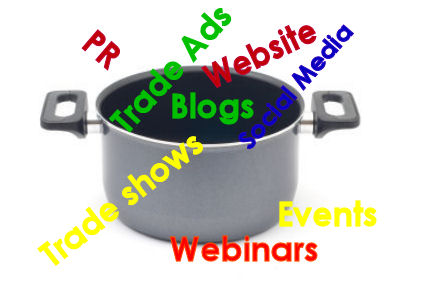 Are you overwhelmed by the number of touch points you have with customers? The marketing mix for many B2B companies today looks like a recipe with an ever-increasing number of ingredients. Imagine the pot is your company. The protein for your recipe is your website and without it, your marketing lacks power. Trade magazines, trade shows and traditional public relations form a base; add blogs; mix in Facebook, LinkedIn, Twitter and You Tube; sprinkle in custom events, networking, webinars, and mobile. It’s either a recipe for success or a recipe for disaster.
Before the Internet, you knew the recipe for B2B marketing success fairly well. Now the recipe has become far more complicated. You can’t just throw in more ingredients and expect it to taste good. You need to think about what each element of the marketing mix can contribute because time and money are limited. You need to think about what customers are looking for and how they engage in each of the platforms.
In the old days a prospect may have picked up the phone and called a vendor to help him in the buying process. Today buyers conduct much of their preliminary research online. Your customers are going to find the information they need from someone. How will you help them? What can you provide that will be useful? How will you stand out in the crowd? How will you build trust? Where will they look for this information?
Here’s a way to simplify the process:
Who do you want to reach? If there are multiple audiences you’ll need separate strategies. Learn as much about them as you can.
Are you after sales leads or brand awareness? Are you trying to establish credibility or educate customers? Choose the “ingredients” of your marketing mix based on your objectives.
Content should also be aligned with objectives. What can you show, what can you say, what have you done, that will help you accomplish your objectives? How will you show it, how will you say it, how will you communicate it on each of your selected channels? This is content strategy.
Some B2B marketers are probably moving too quickly into new media, while others aren’t moving quickly enough. But whether you are just beginning to embrace it, or have already jumped in, taking the time to develop a content strategy will help ensure your success.
Coming soon… Content for Biz will offer a complimentary B2B content strategy worksheet for all our subscribers. Sign up today be sure you don’t miss it.