
How to Convert Customer Knowledge into Content

customer serviceDaniel Russell is a “user happiness” researcher and team leader at Google. It is his job to understand what people do when searching with Google. He teaches classes on Internet search skills and blogs on the topic to share what he knows. He also learns from the users who attend his class and read his blog posts. For his knowledge to become a true company asset it needs to be enhanced, managed and effectively used as content.

Such knowledge driven content encourages companies to stay close to their customers. It can easily adapt to changes in customer needs. It can also find its way into product design if shared properly.

To convert knowledge into content follow these steps.

  1. Customer knowledge is a two way street – give and get.  Daniel’s post on Google’s Inside Search blog is an example of building product and customer knowledge into findable, shareable, credible content. Find a person at your company who can play the role Daniel does at Google.
  2. Enhance. Do not simply store away what is known in a customer management system or database. Teach a class or webinar that allows you to observe and gather. Write a blog post that describes hands-on experience. From it, users will sense something about the company culture as well.
  3. Manage. Daniel doesn’t write just one blog post, but a series of posts on Internet search skills. The content needs to be aligned with company objectives and user interests. He tells us that recent changes have been made for searching images so the examples he uses involve searching for images.
  4. Use Effectively. In your blog posts and classes include examples and new ways to use the product. Daniel shares ideas on using Google Images that the average user would not know: How to verify the gender of a name and how to find a book without its title.
  5. When you need help on how to enhance, manage and effectively use knowledge driven content talk with a content strategist.

What kind of content are you creating with your customer knowledge?
Notes From CONFAB, The Content Strategy Conference

CONFAB was a first of its kind conference held in Minneapolis this week. Planners brought together leaders in the field of content strategy to discuss best practices, dispel myths, and bring thoughtful solutions to business needs for quality content. Here are my highlight notes from the first morning of the two day conference.

What is Content Strategy and Why is it Important?
Definitions, Needs, & Roles

Content is defined as everything that can be uploaded to an online site.

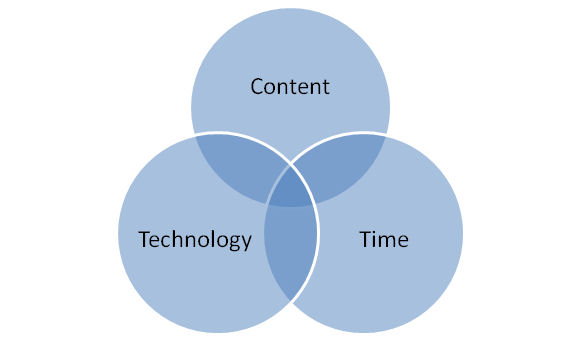
Content needs to be planned prior to launch dates, during, and beyond. Inconsistent content through channels is a problem. Multi-platform content development is critical. Get rid of the silos. Content needs to be nimble. Content is a business asset.

Establish a visual rhythm that is recognizable across channels.

A content strategist articulates, investigates, integrates, appreciates, and ideates. They set procedures for content creation, delivery, and governance. They ask: “How can we make content grow by applying  urgency and purpose?”

SEO cannot solve the content problem. Even Google has abandoned the word “search” in favor of “knowledge”.

Content Curation

Content curators are finders who filter information. Information created up to the year 2003 totaled 5 exabytes. That amount is now being created every two days. “I can’t keep up” was expressed by 46% of survey respondents. Sleeping less was a solution for 34% of information consumers.

Humans are replacing algorithms. Ideas are replacing data. “What are people thinking?” is the question to ask; not “How do I manipulate search engines?”

Choose your endorsements, “Likes,” retweets, links, and posts carefully. That is curating the web.

Listening is more powerful than speaking. Gather, organize, and filter good stuff. Monitor for positive re-enforcement and use it as social proof.

In a noisy world, customers embrace clarity.

Questions That Support Quality Content

Where does our data live and why?

What can people do with our content?

What can they do with what they create from our content?

What is our framework for building content?

What’s working? What is not working?

What kind of place does the content create?

How is the content connected?

What forces does content resolve?

How do you keep control of your own content?

Interactions

Reactive and fragmented response is poor content delivery.

Deliver the right information at the right time to the right audience.

Recommend. Share. Be social.

Serve up content.

Business Needs

Move content from a cost center to a profit center by meeting business objectives.

Marketing focuses on new leads, not base. What does your base need and want? How satisfied are they? Existing customers may be more valuable than new customers.

Teach everyone what good content looks like.

* Thank you Kristina Halvorson, Steve Rosenbaum, Erin Kissane and Valeria Maltoni for sharing your thoughts at CONFAB.