How To Avoid “Catch Up” Content

Content cycles prevent catch up contentPlaying “catch up” with your content usually results in content that lacks focus, repeats what’s already been said, and engages no one. Content planning requires scheduling by time and topic. Here are some ways to avoid catch up content and produce something truly worthy of your company.

Do Your Research

Read through industry association newsletters, news sites, competitor sites, forums and blog posts. Focus on the questions being asked. In a post published on Fast Company’s Co.Exist page these questions appeared: “What happened?” “Time to pop the champagne corks, right?” “Does this mean we should just throw in the towel?” What could you do with these questions relative to your business?

Turn a statement into a question. Here is a statement from Conversation Agent: “Context is where online and offline blend.” This could springboard you into questioning, “How can context close the gap between online and offline marketing?” Answer it the way only you know how. Use your experience, product knowledge or data. Solicit answers from your subject matter experts, sales people or one of your customers. This approach is a breath of fresh air.

Time Your Content Schedule

Content follows cycles so get your wheels spinning. You are a publisher and need to schedule by time. A time example might include: daily (social media), weekly (blog posts, website copy), monthly (newsletters) or quarterly (articles, press releases).

Social media scientists Dan Zarrella discovered that timing could make a difference in response rates. On Twitter, Friday at 4pm ET is the most retweetable time.  Weekends get the most attention on Facebook. Blog posts published between 9 and 10am get more comments. Emails sent early in the morning get the highest click through rate. He reminds his followers, “Talk as yourself, not about yourself.”

Organize by Topic

Content should also be organized by topic. With a list of topics or a brief outline of ideas you can avoid catch up content. I used these topics for the weeks of each month for a year.

  • Content Strategy
  • Social Media
  • Search Engine Optimization
  • Public Relations & Email Marketing

For each post I would define a strategy, answer why it was being featured, where it could be used, and how to apply it effectively.

Bruno Coelho shared with John Jantsch how he organizes his daily blog topics:

  • A question worth answering
  • An action worth doing
  • A lesson worth learning
  • An online Dreampreneur worth following
  • A week worth remembering

Stay on Message & Be Original

Organizing and scheduling your topics keeps you on message and avoids that last minute rush to produce something from nothing. Harvard Business School creativity researcher Teresa Amabile found that people are less creative when under pressure. Ideas are flighty, so write them down when they come. I use the Evernote app to record ideas on the spot in a folder titled Content Ideas. This way you always have a list of ideas to work from.

When content is planned in advance, the catch up mentality doesn’t pervade causing you to produce less than what you are capable of. You are free to be original, informative and thought provoking.

 

Is Your Content Supply Sustainable?

How your content is created can have a great effect on its sustainability and your company’s influence online. A recent Brafton survey of marketers reveals “… more than 75 percent of marketers who believe their content yields high-quality leads update their content multiple times per week, while 55.6 percent do so more than once every day.”

Let’s view content as a company product. To keep your content supply sustainable you need a process, infrastructure, inventory and distribution. Is your content being built in a factory (no customization or audience segmentation), moving to a warehouse (slow updates, technology constraints), then to a platform (website, whitepaper, social channels)? Companies must empower content creators by using a seamless, efficient process.

Create a Value Base Content Flow

Where’s the glue? Content is inspired first by a company’s goals, mission and values. This is the glue that content creators use to make decisions on what to publish. It provides direction and consistency in messaging whether the content is being created on the fly or within a well planned campaign.

Where’s the grease? A well designed, useful product originates from understanding the customer and their environment. Insight on the customer is the grease for delivering content that solves problems, educates or entertains.

Establish an Infrastructure

Content infrastructure should include an inventory of information supplied by various company departments, customers, and industries. This shared supply chain can include industry news, press releases, customer stories, whitepapers and more. Stir it up, connect ideas, and create original content.

Package and distribute the content using technology that supports user generated content, mobile access, live chat and interactive video. Such platforms show your customers that you are present and willing to help them solve their problem at the point of interaction.

Optimize for One Industry and One Product

Companies may be targeting multiple industries and producing multiple products but each of these needs its own content space. Niche content gets found by people seeking a particular solution. Companies can push content out to enhance brand awareness but pull leads in with content that addresses a particular need.

Plan, Collaborate, Forecast, Replenish

A content calendar is the GPS of the content world. It answers questions of what to write, when, where and for whom. It is a critical part of the planning process. Content creation is a collaborative effort that should be shared throughout the company and amongst its customers. Forecasting is a matter of understanding company campaigns and news cycles. Will you be introducing something new or taking action on an issue of concern to customers? What campaigns need content support? Keeping channels open for new ideas, soliciting feedback from customers, and remaining curious are all ways to replenish and keep your content supply sustainable.

Content Lessons From High School Football

Getting to the goal line

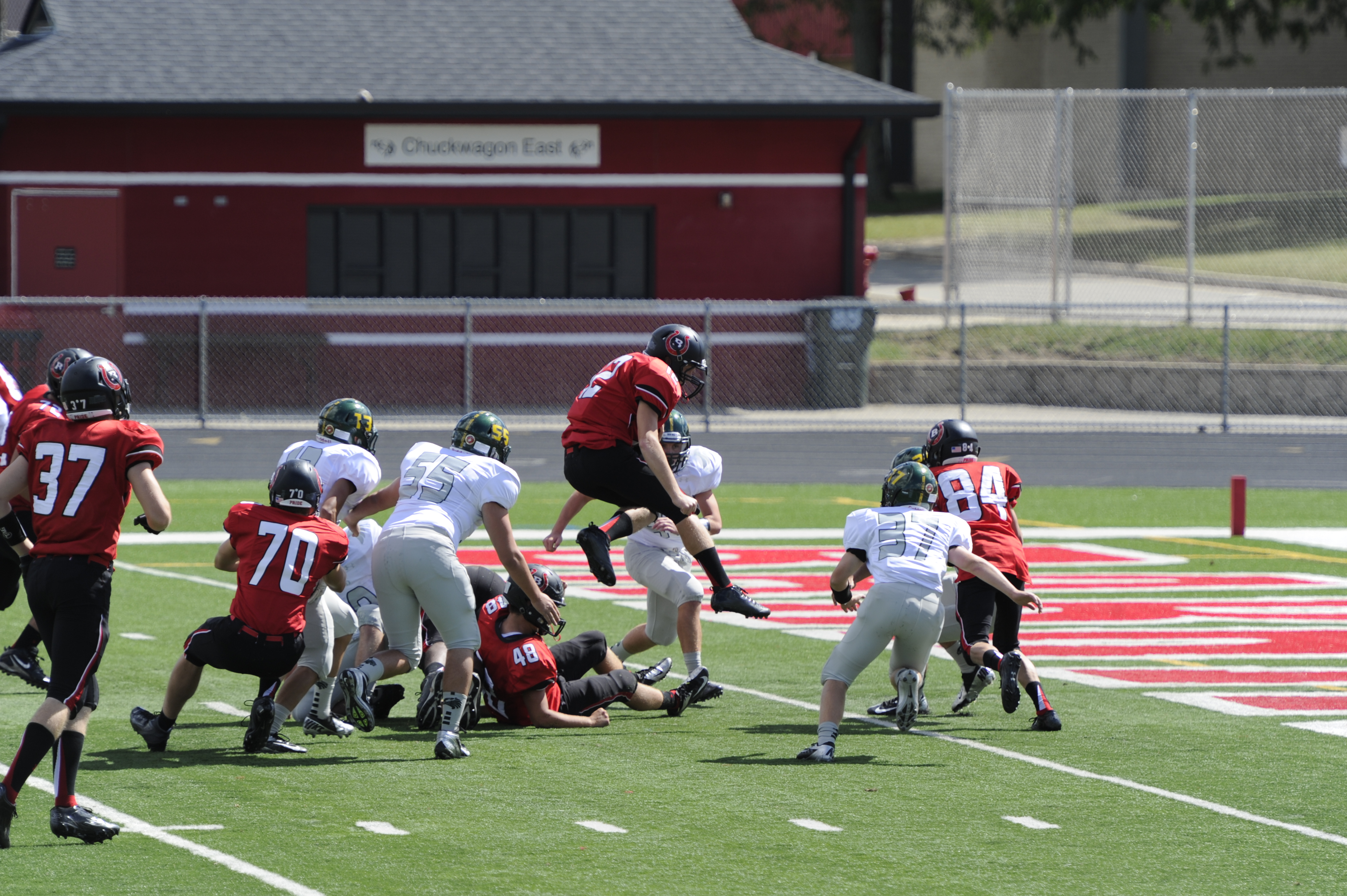
Can a high school football game uncover content lessons for B2B companies? You bet, at least in the mind of this content writer. While watching the game I get an understanding of why it’s important to assess opponents, signal a new play, execute, and connect with an audience. Watch this video that shows a fake handoff by the quarterback, a play that initiates a 65-yard run to score a touchdown. That play didn’t just happen. It was planned.

Understand your Opponents

Your competition is one form of opponent but another is the customer who struggles with his or her end goals, resources and budget. Content that acknowledges those concerns is like good blockers paving the way for the quarterback’s run.

Signal a New Play

If the passes are not caught and the handoffs go nowhere, reimagine your role. No football game is the same and the same holds true for company initiatives. High school kids hear from the coach: “Don’t repeat your mistakes, learn from them.” For companies, content is measureable. Sometimes it takes a bit of tweaking but you can reach your content goals. Yesterday’s content won’t support new ideas.

Execute

Watch what the quarterback does to make the opponent team change direction. You want your content to do the same – get your audience to change direction toward your solution. Get them thinking differently about what is important, performance and balancing cost.

You Gotta Feel It

Include some sensory element that allows your audience to experience emotion. At the football game you hear the roar of the crowd and clapping. Content writers use language and visual design to create mood and tone.

Add an unexpected connection the way this home game announcer did after reporting the touchdown play: “That a boy.” And, “This kid is deceivingly fast.” As for the quarterback, he said: “Just before the play I had a feeling: ‘This is it.” That’s the feeling your content can relay: This is it.

How Content Writers Find Real-Time Industry News In One Place

Find industry newsFinding real-time industry and product news from multiple sources in one place is a massive time saver. It allows content writers to work smarter. With no fees or even login requirements, I find a treasure trove of news by industry, company or product using Yahoo! News. That’s right. Yahoo!  At Content For Biz Inc we deliver content marketing programs for companies mostly in the Transportation, Food Service and Construction industries. Content writers do more than write content. They optimize for search engines and market what they write. They research, listen to and understand the environment in which their clients compete. Here is one way to stay on top of the news.

Begin at this Yahoo! page (http://biz.yahoo.com/pr.html). I am including the whole link here because it’s not easy to find and can be confused with less robust pages on the site. Enter a keyword in the Search News box.  A single listing of what news is being distributed via press releases, wire services and other reputable sources appears.

One of the great features on this page is Filter By Source (something Google News does not have). All Sources is the default. Select Yahoo! Finance to see press releases. Select the New York Times for easy access to their articles. Don’t be surprised if your local newspaper appears as a source.  In fact, put in the name of a product or company and the Source options change. This is a good way to target publications and writers interested in your kind of news.

The next best feature is the Filter By Time. You can see a single listing of press releases, wire service stories and other news in the past hour, day or week. Yahoo! In the same left column under the Filter By Time, Related Concepts generates suggestions for other keywords to use in your search.

With the information I gain I can do the following:

–       Write blog posts related to current issues

–       Add relevant links to social media posts

–       Comment on articles pertinent to client audience

–       Target press releases to relevant publications and sites

–       Find journalists who write about the industry, product or company

–       Gain business intelligence on competitors

–       Create website content that positions client as thought leader

–       Find sources and conduct research for white papers & webinars

Having multiple sources of real-time industry news in one place is a time saver for transportation content writers and marketers in all industries. Finding such news by media source can serve your clients well.

Any thoughts on how you navigate the Internet for relevant information?

Content is a Functional Part of Website Development

Computer screens with contentWebsite development teams often leave content writing up to the business owner or outsource it at the last minute. Such an oversight can postpone the project or render the site unusable. They are missing an opportunity to make the site function as the company intended – as a business tool. If payment is tied to the site going live they may also experience a delayed paycheck.

To build a truly functional website, content writing responsibilities need to be delegated early to a skilled writer who makes content a priority. Just as graphic artists make visual design a priority and programmers make code their priority, content writers delve deep into what the business objectives are for the site. Content begins a conversation between the company and site visitor. Words inform, engage, and when strategically employed, live up to the visitor’s expectation. Visitors don’t expect to be assaulted by ugly design or frustrated by features that crash or content that doesn’t answer their questions.

Keep the Project On Track

I asked some web development pros I know for their views on the content writer’s role. Here’s what Dan Halt, principal at Balta Design, a web development and design firm, has to say:

“The thing that slows us down the most is not having the content ready from the customer. Having the copy written by a content writer, instead of the customer, usually speeds up the process. One of the most beneficial things someone can get from a content writer is their content will be written with SEO in mind. Most business owners don’t have the time to write the content for their site (or at least the quality time it takes). That’s why it’s better to hire a professional, in my opinion.”

Kay Wharton, owner of Wharton Graphics, shared similar ideas. She said, “I prefer at least rough content (headlines and estimate of copy to come) before design begins. I can greek in text, but if I could have all the copy that’s even better. I want the content writer to understand some editing may be necessary to make the copy fit the design. There may need to be a little back and forth during the process.”

Bring in a content writer early for web development projects. The site will likely be completed on time, function well, and meet your business objectives. Companies reap rewards when content writing is prioritized as a functional part of website development.