Contractor Websites Part III: Getting Organized

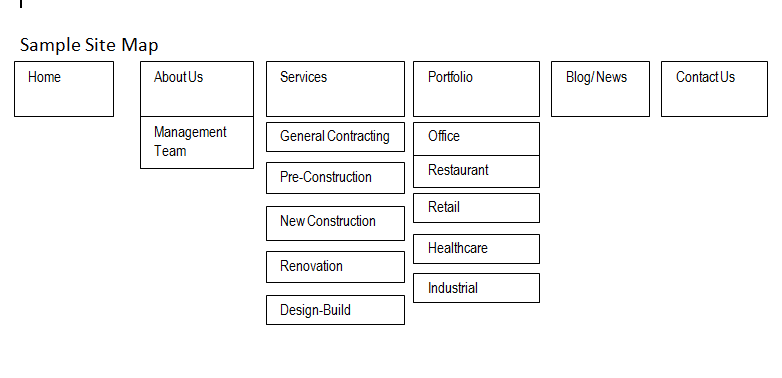
Whether you ask someone else to project manage your new website or do it yourself, the business owner, content and development team needs to be on the same page with what pages are needed and how visitors will navigate through the site. So clients can visualize this, I typically create a rough sitemap that looks something like this:

When deciding if you need a separate page for a service such as pre-construction, it’s useful to think about the key words you want to rank for. Listing services separately vs. one general page for services, provides an opportunity to rank in search engines for different terms. Each page should have a unique purpose. You want to avoid creating similar content on each page.

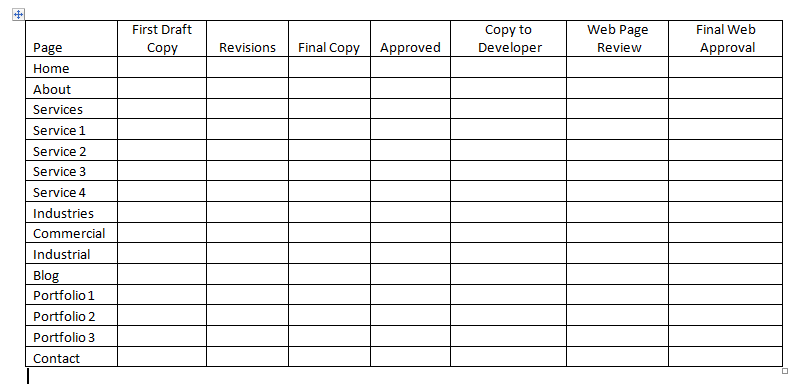
To keep the pages organized I devote each page to a line in an excel sheet with various columns tracking progress across the top. You might have some pages that don’t flow off the main navigation, but might be included in a footer, such as “privacy policy,” “careers” or a form for subcontractors to complete. Be sure to include all of these on your excel sheet.

Graphics

Now that you have a general idea of the content, gather your previous research on sites you like and decide on the look and feel of the site. Keep in one folder all of the identity elements such as the logo and hex values for the company colors.Begin compiling images to support each page including project photos, people shots, awards, etc. Now is the time you want to identify areas where your photos are lacking, so you can either hire a photographer or search for stock images. You don’t want to be fumbling around looking for photos when the site is nearly completed. As much

Select a theme

If you are working with a web developer, they will either create or customize an existing theme for you, based on your needs. However, if you are creating your own website, you will need to find a WordPress theme that fits your objectives. Themeforest has a great selection of templates. With so many choices, the task can be quite daunting. Here are things to look for:

  • Make sure the template is fully responsive on all devices.
  • Make sure the theme will accommodate popular WordPress plugins such as Askimet for spam, Yoast SEO, Contact Form 7 and integrations to your email marketing platform. Plugins can give your site a wealth of functionality. In general, I like a theme has been highly rated by many users and not one only a few people have purchased.
  • If you want to customize the color, make sure the theme supports this. Avoid flashy animations that may slow down your site and keep people from getting the information they need.
  • Make sure you can get support when you need it. Check out the reviews.

Once the theme is chosen, content written and photos selected, you will be ready to get started. While we won’t get into the nitty gritty of creating a website, we will help you learn to evaluate an review your site, upon completion. Next up: Contractor Websites Part IV: Final checklist

What a contractor needs to know about building a website – Part 1: Upfront considerations

Part 1 of a 4-part series on website development

Creating a first website or even a revamp of an existing website is a learning process for most contractors. Most underestimate the time, talent and work that go into a successful site. Projects often hit stumbling blocks because business owners don’t understand all the steps involved. This series of posts takes business owners through the process of building a website sot hey can make better decisions about who they choose to work with, the type of site they design, and how they can best achieve their goals.       

For most businesses the website is center of all marketing efforts, working 24/7 to communicate the value of the business to visitors. As a business owner, you need to put on your marketing hat when developing the website. If you will be seeking help from web developers, content creators and/or graphic designers you need to provide a basic overview of the company’s business and determine what you want your website to accomplish. Here are some of the questions we like our clients to answer.Providing theses up front should save time and resources.

  1. What audiences are you trying to reach? Are there multiple industries or audiences that use your products and services? How will the website address their specific content needs?
  2. What makes your business unique?  The unique selling proposition (USP), is a factor that differentiates a product or service from its competitors, such as the lowest cost, the highest quality, experience, etc.
  3. What services or products do you offer?  Will customers be able to purchase online? What search terms would potential customers type in to find a business like yours online? Do you envision a page for each of the services?
  4. What actions do you want website visitors to take? Do you want them to request a quote, sign up for a newsletter, download a whitepaper?  Do you want them to call, email or chat online?
  5. What are your primary objectives for the website? Do you want to generate leads from organic search? Will you drive traffic from paid advertisements and other listings or do you want to just want a professional website you can refer potential clients to?
  6. Are there any specific business challenges you want the website to address? For example you may want to website to convey that you work for both residential and commercial customers.
  7. What websites do you like and why? Analyze competitive sites and sites outside your industry to determine your likes and dislikes. Similarly, you can provide examples of sites you don’t like. The key elements of the site to analyze are navigation (How easy is it to find things?), content (Is it helpful? Do you like the tone of the copy?) and design (Do you like the colors, type and photos?).

Having these questions answered up front will give developers, designers and content writers a clear picture of what you need and want, right from the start. Just like construction, time spent up front saves time and money later.

Up next: Who is doing what on your website

The Post-CONEXPO-CON/AGG Marketing Challenge

Using content to maximize your investment in North America’s biggest construction show

Topcon booth at conexpo-CON/AGG 2017By now, your feet have probably recovered from CONEXPO-CON/AGG & IFPE 2017, the global mega-construction trade show, held in Las Vegas, NV, March 7-11, 2017. However, if you were one of the more than 2,800 exhibitors that occupied a record 2.8 million-plus net square feet of exhibit space, and attempted to engage with 130,000 attendees, the real work is just beginning.

The most obvious post-show task is to follow-up with those who visited your exhibit. However, studies show that nearly 70 percent of exhibitors at a given trade show never contact a prospect who visited their exhibit booth. While that stat may be shocking, many companies struggle to find the time and resources for post-show follow-up. However, even now, weeks after the show, it’s not too late to take charge of post-show marketing efforts.

There is still time to capture and maintain the interest in your company and products among those who attended CONEXPO-CON/AGG & IFPE 2017 with the goal of establishing a long-term relationship with them.

 Post-Show Success Begins and Ends with Content

Here is a simple guide to post-CONEXPO-CON/AGG & IFPE 2017 content marketing:

  1. Publish content on your company’s website.

The biggest aggravation for any potential or existing customer  is not having current information available online. Immediate access to information is what all consumers demand today.

Be sure that your website is up-to-date, especially with information about the products and services that were displayed at CONEXPO-CON/AGG & IFPE 2017. There are probably more people interested in your products who did not attend the show. Consider this an opportunity to make them feel like they were there.

Include access to product specifications, photos taken at your exhibit and photos of equipment in field situations. If products were demonstrated at the show, be sure to include an action-filled informational video. Include other videos as well. Have a company spokesperson, a product manager or company engineer, explain product features and benefits via video because everyone wants to hear from an informed voice.

Collectively, your online content surrounding the show will enhance your sales message and generate enthusiasm and leads among website visitors.

2. E-blast content to those who visited your exhibit.

Be proactive with attendees who visited your exhibit.  Send a personalized email to everyone who visited.  It should say something like, “Dear Mr. Smith. Thank you your visiting our exhibit booth at CONEXPO-CON/AGG & IFPE 2017. Here is product information about…” The email should link to a digital pdf or web page highlighting your company’s activity at the show, including information about the products and services displayed. To drive response, include as many responsive offerings as possible so you’re not limiting content directed toward a narrow group or low level of interest.

Link to videos of the displayed products working on a job site, specifications, case histories, testimonials, and white papers. Remember, the more relevant content and links you offer, the better chance the recipient will engage in your products, services and company. If possible, include the name of the attendee’s local dealer/distributor or outlet where your products can be purchased, if not, provide the full list.

Finally, include a call to action. Provide the recipient with specific options for engagement, such as “Download our case history,” “Read our white paper,” “Request a product demonstration,”  “Download product specs,” and more.

After the person engages, ask for additional information. This can provide you with new intelligence for more successful follow-up efforts. For example, you might ask about the size of the company, products owned or when they plan to purchase.

Be sure to track and store info on who engages with the e-blast content for further follow-up. For example, if Mr. Smith clicked on the link for Product A, be sure you include him on a list of those interested in Product A.

3. E-blast content to those who did not visit your exhibit booth, but attended the show.

As an exhibitor, you can purchase a list of those who attended the show. Request the list by the type of business that reflects your ideal prospect.  (i.e. highway contractor, building contractor, sales volume; etc.) After you receive it, remove the names of anyone who visited your booth.

Now create a similar e-blast to those who visited your booth, with a link to a digital pdf or web page highlighting your company’s activity at CONEXPO-CON/AGG & IFPE 2017.

The email for non-visitors should also personally addresses the attendee, saying something like, “Dear Ms. Jones. We’re sorry we missed you during CONEXPO-CON/AGG & IFPE 2017, but wanted to be sure you were aware of the new products and services we had on display at the show…”

The same recommendations for content, calls to action and database management apply to the email for non-visitors of your booth.

4. Use social media for post-show content.

In addition to your website and email follow-up, use social media channels to reach CONEXPO-CON/AGG & IFPE 2017 attendees and others of interest to your company. Facebook, Twitter and LinkedIn can be particularly helpful in spreading the word, both domestically and globally. These platforms open the possibility for connecting with other customer groups of interest to your company.

One particular way of using social media is by rolling out, on a daily or weekly basis, a link featuring a product displayed at CONEXPO-CON/AGG & IFPE 2017.

5. Product blog posts extend the value of your investment in CONEXPO-CON/AGG & IFPE 2017.

What better way to get a dialogue started about your products and company than through a blog that can be included on your company website and in e-blasts to your CONEXPO-CON/AGG & IFPE 2017 list?

Let readers ask questions. If you wish to avoid a “comments” section, then include a Q&A, which allows you to maintain control of the conversation. You might even call it “Q&A from the CONEXPO/CON/AGG Show”.

Blogs can also include videos, testimonials and just about any other original or repurposed content you wish to make known. Answer the questions that potential customers might have about new products and new technologies.

6. Explore Augmented Reality and Virtual Reality Content

Augmented Reality and Virtual Reality have arrived and will soon be staples of business-to-business marketing programs. Each technique can be embedded in your content and can serve as an integral part of your CONEXPO-CON/AGG & IFPE 2017 promotion.

Augmented Reality provides a live direct or indirect view of a physical, real-world environment whose elements are augmented (or supplemented) by computer-generated sensory input such as sound, video, graphics or GPS data.

Engagement in Augmented Reality (AR) is relatively easy. In its simplest form, the recipient downloads your AR app (Free from a Google or Apple store). Much like a QR code, the app will scan a code you provide with the recipient allowed to view what you have offered on their phone or other mobile device.

In the case of CONEXPO-CON/AGG & IFPE 2017, the AR offering could be everything you’ve offered on your website, through e-blasts and social media, and more!

Virtual Reality (VR) simulates a real or imagined physical event. Many companies now use VR in product training or to demonstrate a product’s capability..

With the excitement of virtual reality, you might offer various twists and turns to enhance the understanding (and the excitement) of your products and services.

Use Content to Your Advantage

Instead of fretting over the trade show bills, it’s time to allow content, both original and re-purposed, to amortize your company’s investment in CONEXPO-CON/AGG & IFPE 2017. Most of what you need is already at your fingertips. Take the extra steps you need to continue the momentum created by a successful exhibit. If the statistics are correct, you will be among the 30% of companies who are taking trade show follow-up seriously.




Why Contractors Need to Embrace Review Sites

Word of Yelpmouth has always been important for local businesses. But today, word of mouth advertising happens over review sites and social networks. It’s not just restaurants and doctors that need to worry about the damage caused by negative reviews, but contractors too. Businesses who try to avoid reviews do so at their own risk.



A 2016 study from BrightLocal revealed that 84% of consumers trusted online reviews as much as a personal recommendation.  Eighteen percent said they had read reviews for tradesmen – up 7% from 2014.  Through research conducted over several years Bright Local believes that consumers have more grown accustomed to reading reviews, and have expanded their search for reviews beyond restaurants (60%), to medical/healthcare (31%), and other types of businesses.

The number of places consumers can find reviews have grown considerably. Included are search engines and social media sites such as Google, Bing, Yahoo and Facebook; general review sites such Yelp and Better Business Bureau and TrustPilot, as well as dedicated home services websites such as Angie’s List, HomeAdvisor and Thumbtack.

What’s the ideal number of reviews? A 2015 Northwestern/PowerReviews Research study found it depends on the length of the reviews themselves. When reviews are shorter, more reviews matter. When reviews are longer,the number of reviews has a less significant impact.

The Northwestern study also found when the star rating surpasses 3, so does likelihood of purchase. Similarly, only 14% of respondents in the BrightLocal study would consider using a business with a one or two-star rating.

Don’t expect reviews to flow in on their own. You need a strategy. You also need to be sure you know the rules when it comes to soliciting reviews. While Google encourages businesses to request reviews, Yelp strictly forbids it. And don’t be surprised if overly positive reviews are excluded by Yelp. It is at their discretion to exclude them.

Start by claiming your business page on sites such as Google+local, Yelp, and other sites where it is free to be listed. Other sites such as Home Advisor and Thumbtack while free to consumers, are lead generation sites for their contractor members. Businesses have no control over getting on Angie’s List and Consumer Checkbook. A contractor would need to be rated by a subscriber before a company is placed on Angie’s List. Consumers Checkbook requires a minimum number of subscribers who rate the business.

Let customers know the importance of reviews to your business. It will increase the chances of a customer providing a review. Make it as easy as possible for the customer to leave a review. Include a card with your final invoice that indicates all the places where customers can leave a review. You can also provide links from a page on your website and direct people there.  Timing is key to getting a good quality review. Right after the job is complete, customers will be able to provide the most detailed reviews, as everything will be fresh in their memory.

Monitoring reviews should be a part of your overall strategy. Encourage customers to leave detailed reviews. Potential buyers read the reviews for a number of factors including the scope of the work, accuracy of the quote and if you maintained a clean job site.

Business owners need to think about reviews as an opportunity, not a liability. With reviews for your business online, word of mouth can spread faster, and to more people than ever before.  By taking care of your customers and following the review policies for each site, we think the good outweighs the bad.

What the Chicago Cubs Can Teach Us About Content Marketing

Chicago Cubs signThe Chicago Cubs won the World Series in a nail biting extra inning game 7 against the Cleveland Indians. It was deadline time. The event became historic not because they always win but because they have not won the Series for 108 years. History can be on your side either way. Down three games to one it’s an inspiring comeback story.

Here are some lessons from the Series that content marketers can use when the daily grind of producing stellar content may be getting the best of them.

Start big

Game 7 started with Dexter Fowler hitting a home run. Koci Hernandez, professor of new media at UC Berkley says, “Start a new project with reckless abandon.”

Forget the past

Focus on what you need to do now. Stay in the moment. Yet once you’ve met your goal pay tribute to whatever and whomever brought you to this point.

Don’t try to do too much

When a fan asked a rookie player what advice Cubs Manager Joe Madden gave him when he joined the team, Madden’s phrase “Try not to suck”, stuck and became a rallying cry. You don’t have to swing for the fences. Put the ball in play and good things will happen.

Get the routine down

Stick with it, day after day. When you are ready this allows you to step out of the routine and become extraordinary. Hernandez says, “The unrelenting pursuit of practice separates you from others.”

Chicago Cubs batterWork together

Cubs veterans and rookies relied on each other. When Pitcher Jon Lester entered the game with two outs, so did 39-year old Catcher David Ross. In content marketing old and new, creative and technical can be a winning combination.

Be Willing to take a risk

Joe Madden made some controversial decisions such as bringing closer Aroldis Chapman in to pitch in five games during the Series. It worked out.

Loyalty Matters

For a very long time Cubs fans have had limited expectations for their team. Yet they remain enthusiastic because they love the game. Give your best to those who support your efforts.

Chicago Cubs parade celebrationExpect the Unexpected

Throughout the Series second baseman and 8th in the batter line up Javier Baez was swinging at everything and missing. Then leading off the fifth inning of game 7 he hit a homerun. What? Pitcher Corey Kluber left the mound without a single strikeout. Goliath can be conquered.

Don’t Rely on the Environment

The Cubs lost two of their three games while at home in Wrigley Field. Step out of your comfort zone. Get a fresh look at things and dig in.

Step Up When Needed

After nine innings in a tie game, Jason Heyward was credited with rallying the team during the rain delay. Of that meeting in the weight room he said, “I just had to remind everybody who we are, what we’ve overcome to get here.” Good advice for everyone.

It’s a team effort

To build a team culture you have to respect every player. Miguel Montera drove in what would be the winning run for the Cubs. Kyle Hendricks and Anthony Rizzo fielded the last out. But it was teamwork that won the game. Chciago Cubs team spirit

Thank everyone

In Chicago’s Grant Park during the celebration parade and rally the owners, managers, coaches and players thanked their fans and the city of Chicago. They thanked player families, team secretaries, scouts and everyone who wore the jersey before them. Fans at the celebration rally said they won’t forget how Anthony Rizzo choked up and fought back tears as he introduced Catcher David Ross, “Someone who on and off the field taught me how to be a better person.” Emotion moves people.

Your work may not be celebrated as the win of a century. But if you can bring some passion to the work, embrace the challenge, work as a team and get to the finish line I think that’s something to cheer about.


Save

Save

Save

Save

Save

Save

Save