Need Fresh Content? Change Your Mind, Don’t Judge, Give Access

A creek running through the woods.Fresh content requires new ideas. And new ideas need good starting points. Smart Thinking author Art Markman says that how we describe a creative problem is the start line for our memory to find related concepts. If you start with a traditional way of thinking you are likely to stay stuck with stale, not fresh ideas. Be willing to re-frame the problem and explore your existing knowledge in a new way. Don’t be afraid to change your mind. Here are a few ways of doing this.

Personify things: If bulldozers could talk they would ask for …what? Fill in the blank.

Add context: Lemons are generally thought of as being tart and sour, but when served as part of a dessert their sweet side comes out.

Opposites attract: Think of the opposite to your initial thought – square vs. round, or train tracks vs. open seas. Play with the ideas.

Broaden The Vision, Don’t Judge

Research on academically gifted children shows they are more likely to think about the big picture first and work their understanding down to the finer details. Starting this way can connect seemingly unrelated thoughts resulting in ideas that intrigue and engage your audience. When you clear your mind and welcome the unexpected, fresh content ideas will emerge.

However, when performing creative tasks people tend to narrow their vision if they are being evaluated or judged by some external force. To find fresh ideas, put curiosity in the driver’s seat. Any reward or judgment should be self-initiated. Consequences threaten new ideas. One’s focus turns to the consequence rather than the creative act.

Give Access

Freedom of thought goes beyond one’s cognitive ability.  Allowing a content writer access to executives, subject matter experts, sales reps, customers, product demos, and industry events will greatly impact the type of content created. I recently heard author John Bredar speak about his book, The President’s Photographer. History shows that US Presidents who allowed their chief photographers unrestricted access leave a more thorough and engaging record of their presidency than those who limited access. The Presidents could control what was published. Company presidents can do the same. Bredar’s book is full of images that are both ceremonial and personal. His narrative includes details that only an on-the-site writer could reveal.

Strategy, research and refinement are important too when creating fresh content.  Yet, during the beginning stages a content writer’s mind needs to wander. Research shows that creative ideas cannot be forced. They pop up while in the shower more often than while behind a desk. Like the presidents who decided to trust their photographers, content writers learn to trust their ideas. The result is authentic, interesting and original content. Your company is one of a kind. Your content should be too.

Whose Job Is It To Do Content Writing?

content writing inboxIs this a question you hear asked at your company? It seems that business content writing at times is everyone’s job and no one’s job. That’s a problem. When you view content as a deliverable product or service to your customers a schedule gets created and responsibility is doled out. Recent research from Technorati shows B2B companies that blog generate 67% more leads per month. Is your company capable of sustaining a regular content cycle? That is what’s required for the content marketing effort to be effective in bringing new visitors to your website, adding subscribers/followers and generating leads.

Asking whose job it is to do content writing deserves an answer. The answer depends on available resources and type of content needed.

Informative content

Don’t look to your marketing manager to write daily or weekly blog posts, newsletters, articles, or press releases. It won’t get done. They are often big picture thinkers juggling multiple projects. They understand campaigns, themes and scheduling but often need help identifying relevant topics, researching, and actually writing the content. Like a film producer, they provide direction and approve the content for publishing.

Educational content

Don’t look to your subject matter experts. They are very knowledgeable about their subject and hold great insight. But, they may not be skilled in crafting a narrative. They often write as if everyone knows as much as they do, which most likely is not the case. They are however, good resources for the content writer who is skilled in interviewing subject matter experts and translating specialized knowledge into easily understood, interesting prose.

Customer-focused content

Don’t look to your sales force. They are often very good at communicating with customers. However, the written word or visual depiction of a company’s message is not as fluid as a personal conversation, meeting, or phone call. The skill sets are different. Because sales people are in front of customers they are a valuable resource for knowing what questions your content should answer and what challenges your content should describe. Any time spent writing content takes them away from what they really want to be doing, selling.

Social Content

Don’t look only to young people to create social media content. Just because they know how to use the tools doesn’t mean they understand business.

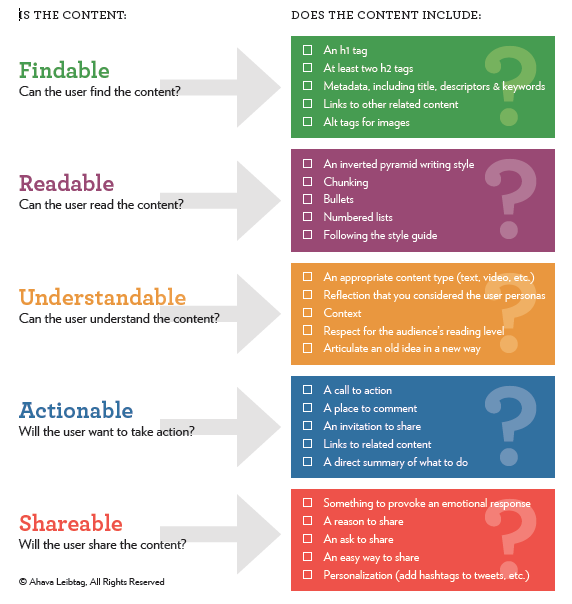
Best intentions fall to the wayside or fail because companies are not relying on the right professionals to meet their content marketing goals. Here is a content checklist created by Ahava Leibtag that shows some of what needs to be considered in creating effective content.

Content Writing Table


Look for people in your company who have experience as journalists, publishers, copywriters, and marketers with proven writing skills. If you can’t find them within your company, look for outside resources. Such professionals understand schedules and deadlines. They prioritize your projects and work as part of your team. They will know what to write and how to write for your particular audience and channels.

When it comes to business content writing projects, don’t make assumptions. The next time someone asks, “Whose job is it to do content writing?” you will have an answer.


Is Your Content Animal, Vegetable or Mineral?

Canyon riverSome companies value their content as much as the products they sell. As a service content can explain the benefits of big data or sell soda. It works as a trade: You give me your contact information and I will let you download my content. But like a chameleon content takes on different textures and tones. At Content For Biz we provide content writing services for B2B companies. Part of our mission is to help clients think differently about content. So, rather than describe content as a commodity using the product, service, trade triad, let’s use animal, vegetable or mineral to classify it. Know what your content is before content writing begins.

Mineral Content

This is foundation content. It is the closest thing to being “written in stone” at least for the time being. It is inert, nonreactive, yet identifying. Mineral content can be a statement of fact, approach or philosophy. A mission statement, a description of your blog’s purpose, even a white paper can be considered mineral content because it is mined with a beginning and end. Each year companies should establish 3 high-impact ideas to create their content around. These are the gems – the sparkle that makes you different, effective and efficient.

Vegetable Content

This is outgrowth content. It is created to grow an audience, nurture leads, and offer a harvest of how-to’s or what ifs. Like a garden it is cyclical, changing by the season. Vegetable content may consist of blog posts, email marketing campaigns, press releases and website copywriting. This kind of content supports the marketing effort throughout the sales cycle. It is picked and easily digested by the customer. Vegetable content can make its consumer smarter, more aware and decisive.

Animal Content   

This is active content. It is instinctive, perceptive and needs to be fed often. Social media is its arena, but also events, newsletters, apps or webinars. The creator of animal content knows which way the wind is blowing. A strong business sense is required to move in the right direction, on the right path. Animal content appears as a peer, not a pest. A friendly approach creates a climate where conditions favor both buyer and seller.

The identifying, outgrowth and instinctual nature of content makes it more like a river chiseling its way through a canyon than a faucet filling a glass of water. If you want to think differently about the content you publish, give us a call.

Writing Content for a Startup Business

Every week we hear from people wanting content for a startup business. As an established content writing company we also work with many established companies. Often times the folks at the startups cannot answer the questions we need to ask as content writers. Here’s a heads up for those planning to use content writing services for a startup business: broad, unfocused answers are your enemy. In the scenario below I include how an established company (pro) might answer the same questions to draw a contrast. Do-it-yourselfers may benefit from this exercise as well. Here is how my line of questioning starts.

Question 1. Please tell me about your business. 

STARTUP: “We want to sell new super duper peeler widgets to food services companies.”

PRO: “We are introducing a new widget that makes peeling more efficient, saving time and money for midsize foodservice companies in the USA.”

The pro knows what they sell, to whom and why someone would buy it.

Question 2: Who is your target audience, your target market?

STARTUP: “Everyone looking for peeler widgets. We don’t want to miss anyone.”

PRO: “Executive chefs in the hospitality industry with a staff of at least six people.”

The pro knows that a target market is defined and exclusive. This is what makes the potential customer identify with the brand. Anyone. Everyone. Is no one. Customer focused content makes them aware of the product and how it will benefit them.

Question 3: Why would they buy it from you? Core strengths of your company?

STARTUP: “It’s a great product and we can serve them well by getting it there on time.“

PRO: “We’ve been serving the foodservice industry for 10 years and understand our customers need durable, reasonably priced, time saving tools that make food preparation more efficient.”

Has the startup identified urgent delivery as a major problem/solution for foodservice companies interested in peeler widgets? I don’t think so.

Question 4: Who is your competition?

STARTUP: “It’s a new product so we don’t have any competition”.

PRO: “XYZ has a similar product on the market, but ours is sharper and quicker. ABC dominates overall in commercial kitchen supplies. Yet, the biggest challenge is in getting chefs to change the way they are currently doing things. We have a video demo so they can see for themselves how efficient the tool is.”

Question 5: What do you want the content to do for you?

STARTUP: “We hope it will generate leads, affirm our existence in the market, get us ranked high in Google search, and more.”

PRO: “Website content is a base for our overall content marketing strategy.  It supports our brand, offers relevant information to existing and potential customers, and gives us a means to measure customer engagement.”

Content is a dilemma for the unfocused startup. They are strongly in need of content writing services to hone their message and compete. To be successful startups should know what advantageous they offer, their target audience/market, their strengths, competition, and what they want their content to do so we can write meaningful, compelling copy that meets the needs and interests of their audience.

Can Content Change the World? A Tribute

This is a day to pay tribute to Martin Luther King, Jr. with this year being the 50th anniversary of his I Have A Dream speech and to President Barak Obama as he makes his second Inaugural speech. It is the way these two men choose words, employ tone and create mood that encourages listeners to believe something better lies ahead. To change the world, apply some of the same rhetorical skills King did and Obama does.

Add Context

They understand why they are in front of an audience and offer context using historical references. President Obama opened his speech today with these words:

“Each time we gather to inaugurate a president, we bear witness to the enduring strength of our Constitution. We affirm the promise of our democracy. We recall that what binds this nation together is not the colors of our skin or the tenets of our faith or the origins of our names. What makes us exceptional – what makes us American – is our allegiance to an idea, articulated in a declaration made more than two centuries ago.”

Martin Luther King, Jr. began his I Have a Dream speech this way:

“Five score years ago, a great American, in whose symbolic shadow we stand signed the Emancipation Proclamation. This momentous decree came as a great beacon light of hope to millions of Negro slaves who had been seared in the flames of withering injustice. It came as a joyous daybreak to end the long night of captivity.”

Understand the Challenge

King: “One hundred years later, the life of the Negro is still sadly crippled by the manacles of segregation and the chains of discrimination…So we have come here today to dramatize an appalling condition. “

Obama: “Today we continue a never-ending journey, to bridge the meaning of those words with the realities of our time. For history tells us that while these truths may be self-evident, they have never been self-executing…”

Share Your Values

King: “In the process of gaining our rightful place we must not be guilty of wrongful deeds. Let us not seek to satisfy our thirst for freedom by drinking from the cup of bitterness and hatred. We must forever conduct our struggle on the high plane of dignity and discipline.”

Obama: “Our celebration of initiative and enterprise; our insistence on hard work and personal responsibility, these are constants in our character…And we must be a source of hope to the poor, the sick, the marginalized, the victims of prejudice – not out of mere charity, but because peace in our time requires the constant advance of those principles that our common creed describes: tolerance and opportunity; human dignity and justice.”

Offer Hope

King: “But we refuse to believe that the bank of justice is bankrupt. We refuse to believe that there are insufficient funds in the great vaults of opportunity of this nation… Nineteen sixty-three is not an end, but a beginning.”

Obama: “We are true to our creed when a little girl born into the bleakest poverty knows that she has the same chance to succeed as anybody else, because she is an American, she is free, and she is equal, not just in the eyes of God but also in our own.”

Make it Personal

King: “I have a dream that my four children will one day live in a nation where they will not be judged by the color of their skin but by the content of their character.”

Obama: “But the words I spoke today are not so different from the oath that is taken each time a soldier signs up for duty, or an immigrant realizes her dream. My oath is not so different from the pledge we all make to the flag that waves above and that fills our hearts with pride.”

Call For Action

King: “It would be fatal for the nation to overlook the urgency of the moment and to underestimate the determination of the Negro…And as we walk, we must make the pledge that we shall march ahead. We cannot turn back.”

Obama: “My fellow Americans, we are made for this moment, and we will seize it – so long as we seize it together… We must act; we must act knowing that our work will be imperfect. We must act, knowing that today’s victories will be only partial…”

End on a Positive Note

Martin Luther King, Jr. ended his I Have a Dream speech this way:

“This will be the day when all of God’s children will be able to sing with a new meaning, ‘My country, ’tis of thee, sweet land of liberty, of thee I sing. Land where my fathers died, land of the pilgrim’s pride, from every mountainside, let freedom ring.’”

President Obama ended his second Inaugural speech with these words:

“Let each of us now embrace, with solemn duty and awesome joy, what is our lasting birthright. With common effort and common purpose, with passion and dedication, let us answer the call of history, and carry into an uncertain future that precious light of freedom.”

Stay inspired. Content can change the world.